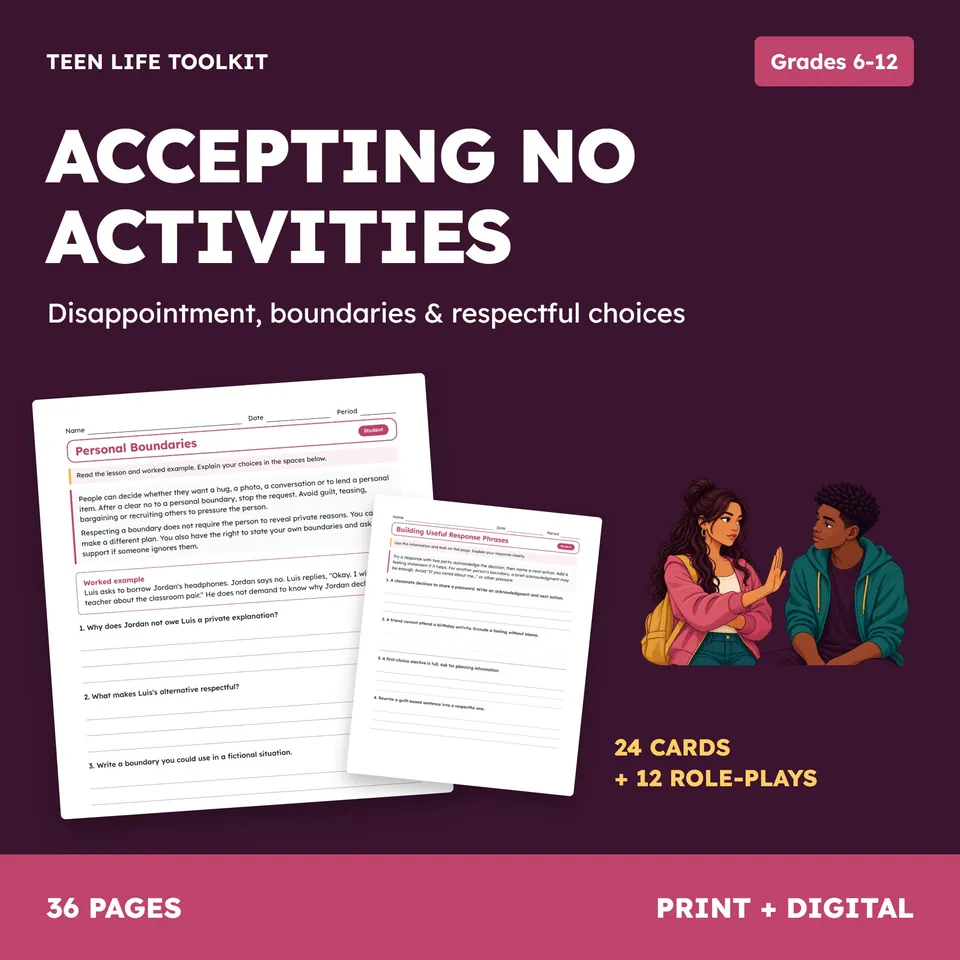
Accepting No Activities for Teens
Handling Disappointment & Boundaries
- Grades
- Grades 6–12
- Formats
- Google Slides, PDF, PowerPoint
- Pages
- 36
- Answer keys
- Included
Opens our store on Teachers Pay Teachers, where you can see the full preview and buy.
Teach a response to disappointment that respects personal boundaries while keeping access and safety needs clear. These Accepting No activities for teens use short lessons, realistic scenarios and paired role-plays to practice an acknowledgment, a clarifying question, a workable alternative or a support request. The distinction between a peer's boundary and an unmet access need gives teachers a useful starting point for discussion.
What's included
- Teacher guide with a 6-session sequence, materials and differentiation: support, on level and challenge
- Printed standards/skill connections and page-by-page contents
- 6 lessons on meanings of no, disappointment, personal boundaries, clarification, a plan B and useful response phrases
- Category practice and an activity comparing possible alternatives
- 24 boundary and limit scenario cards with 2 recording sheets
- 12 paired role-play cards with 2 review pages for rehearsing responses and giving feedback
- Pressure-recognition practice and a boundary case in a shared project
- Practice and Retry Log and My Response Plan
- Final choices-and-boundaries check and a separate case about a refused access support
- Complete answer keys and model responses, plus a conversation rubric
How to use it
Use in school counseling, SEL, advisory, special education or life skills groups. Follow the 6-session sequence, or choose a lesson and matched cards for a focused conversation. Low prep: print the response pages and cut the 24 scenario cards and 12 paired role-play cards for stations; display them instead if that suits your group. Rehearse with fictional situations and allow students to pass on personal sharing. Respecting a personal boundary is kept distinct from accepting a loss of necessary access or safety; students can seek appropriate adult support.
Skills practiced
Handling disappointmentPersonal boundariesRespectful communicationClarifying questionsComparing alternativesSelf-advocacyRecognizing pressureReflection