Listening & Following Directions Activities for Teens
Classroom Listening
- Grades
- Grades 6–12
- Formats
- Google Slides, PDF, PowerPoint
- Pages
- 40
- Answer keys
- Included
Opens our store on Teachers Pay Teachers, where you can see the full preview and buy.
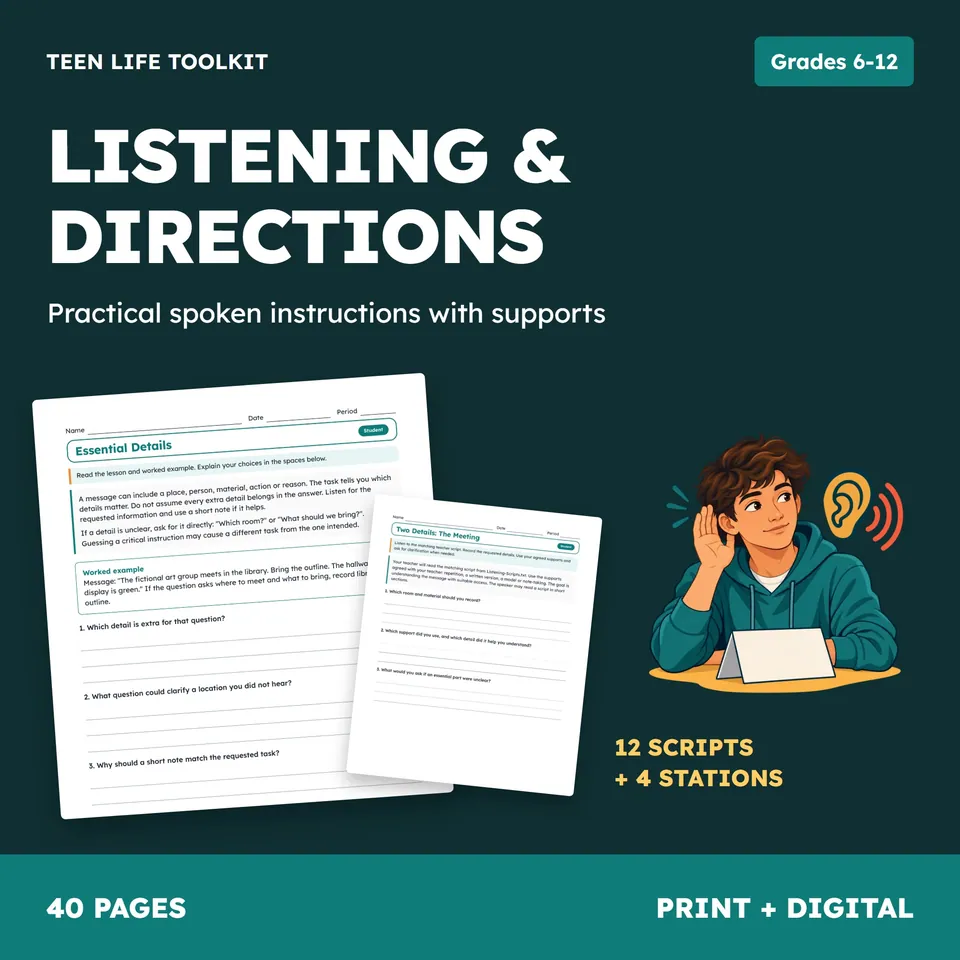
Make spoken directions easier to teach, practice and discuss with teens who need clear access supports. These Listening & Following Directions activities progress from short messages to sequences, updates, routes and practical notes. Separate teacher scripts and student response pages let you model the message, record the support used and check what the student understood.
What's included
- Teacher guide with a 6-session sequence, materials and differentiation: support, on level and challenge
- Printed standards/skill connections and page-by-page contents
- 4 lessons on understanding speech, essential details, order and updated information
- 12 graduated teacher-read tasks with student response and support-reflection pages
- 4 practical listening stations: a route grid, schedule update, phone message and preparation process
- 3 clarification activities for missing details, conflicting information and a support that does not yet fit
- 2 listening-check pages: a starting-point message and a new message, with supports recorded
- My Listening Support Plan and a library-instruction transfer case
- Bonus: Listening-Scripts.txt with 18 teacher messages: 12 graduated scripts, 4 station messages and 2 check messages; scripts stay separate from ordinary student pages
- Complete answer keys and model responses, plus a listening-task review rubric
How to use it
Use in life skills, special education or supported classroom communication lessons, in a group or individual practice. Follow the 6-session sequence and read the matching messages from Listening-Scripts.txt; no audio equipment is required. Low prep: print the response pages, route grid and schedule; no card cutting is required. Use the learner's agreed repetition, written version, short sections, model or quieter setting, and share the script after the first round to check notes. These educational activities do not diagnose or treat auditory processing disorder, and the check pages are not standardized progress measures.
Skills practiced
Essential spoken detailsFollowing directionsSequencingUpdating informationNote-takingClarificationChoosing access supportsSupport reflection