Big Problem vs Small Problem Activities for Teens
Scenarios & Problem Solving
- Grades
- Grades 6–12
- Formats
- Google Slides, PDF, PowerPoint
- Pages
- 36
- Answer keys
- Included
Opens our store on Teachers Pay Teachers, where you can see the full preview and buy.
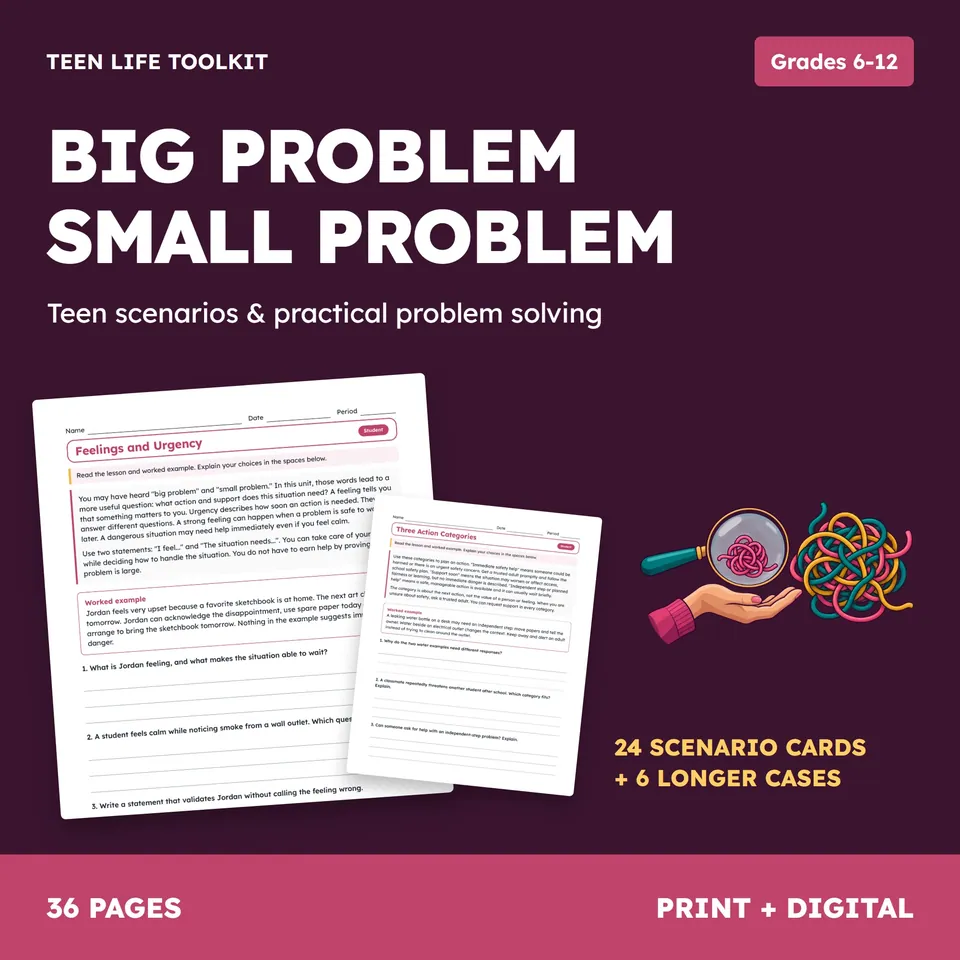
Give teens a clear way to decide what a problem needs while respecting how they feel. These Big Problem vs Small Problem activities use relatable school, community and work scenarios to separate feelings from urgency, check the facts and choose a useful next step. Worked examples and complete models help you teach the reasoning behind each response.
What's included
- Teacher guide with a 6-session sequence, materials and differentiation: support, on level and challenge
- Printed standards/skill connections and page-by-page contents
- 4 mini-lessons on feelings and urgency, action categories, context and useful responses
- Guided practice in separating facts from guesses, making a specific help request and revising a plan when information changes
- 6 longer teen cases covering a group chat, delayed bus, uneven group work, a customer complaint, a repeated boundary and missing materials
- 24 problem-solving scenario cards with 2 recording sheets
- Action-category sorting and a partner problem-solving conversation
- My Action and Help Plan with prompts for a next step, support and follow-up
- Final reasoning check and a changed field-trip plan for applying the skill in a new situation
- Complete answer keys and model responses, plus a reasoning rubric
How to use it
Use in SEL, advisory, life skills, special education or school counseling, with a whole class, a small group or individual support. The 6-session sequence moves from modeling and guided practice to longer cases, cards, a help plan and a final check. Low prep: print selected pages and cut the 24 scenario cards only if using physical stations; they can also be displayed. Use fictional examples when preferred, keep personal reflections private and follow school procedures for safety concerns. The activities practice classroom decision making; they do not judge whether a feeling is too large or diagnose a condition.
Skills practiced
Problem solvingFeelings and urgencyFact checkingHelp-seekingContext awarenessDecision makingSelf-advocacyPlan revision