Coping Skills Activities for Teens: SEL Lessons for Middle School
Good coping skills activities for teens are short, practical and taught like any other skill: notice what's happening in your body, try a strategy, decide which ones work for you, and write them into a personal coping plan. The lessons below fit advisory, health, social-emotional learning (SEL) or a counseling group in middle and high school. They are classroom SEL lessons, not therapy, and any student who may be in crisis should be connected with your school counselor or mental health staff right away.
Before you start: keep it safe and age-respectful
Teens can tell when an activity was designed for younger kids, and they shut down fast if they feel put on the spot. A few ground rules help coping lessons land:
- Make participation a choice. During breathing or grounding, students can keep their eyes open, look at a spot on the desk, or simply listen. Nobody has to share how they feel.
- Use fictional teen scenarios first. Group chats, tryouts, a job shift, a test nobody studied for. Personal reflections stay private unless a student chooses to share.
- Talk to your counselor before the unit. Let them know what you're teaching and when, and agree on what you'll do if a student shares something serious.
- Know the line. If a student says something suggesting they may hurt themselves or someone else, or that someone is hurting them, follow your school's procedures immediately and bring in the counselor. Don't promise to keep it secret.
Teach the 988 Suicide & Crisis Lifeline (call or text 988) as part of help-seeking, alongside the names of trusted adults in your building.
Lesson 1: noticing body signals (interoception)
Before students can choose a coping skill, they need to notice that they need one. Interoception is the sense that tells us what's happening inside our bodies: hunger, thirst, tiredness, a racing heart, tight muscles, a knot in the stomach.
A 20-minute lesson:
- Warm-up (5 minutes). List body signals on the board. Ask, "What does your body do right before a test? Before a game?"
- Same clue, different meaning (10 minutes). A fast heartbeat can mean excitement, nerves, anger, or that you just ran up the stairs. Students match body clues to possible meanings and see that context matters.
- Check-in scale (5 minutes). Students rate one signal on a 1 to 5 scale. Keep using the same scale for quick daily check-ins.
For students who use AAC (augmentative and alternative communication) or visual supports, add picture cards like "I need a break" so they can tell an adult what their body needs.
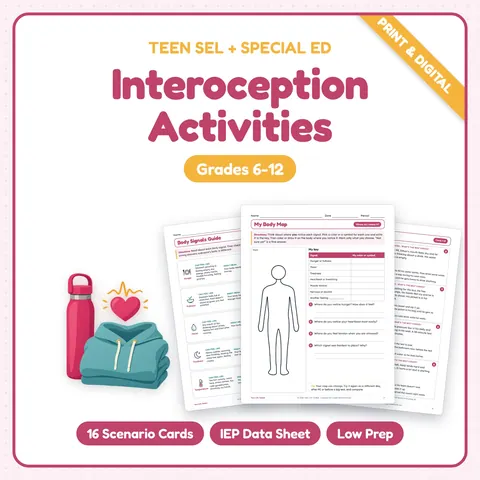
Interoception Activities for Teens includes a body signals guide, a personal body map, eight visual check-in scales, matching and scenario cards, visual support cards for pointing or AAC, and a "When my body says..., I can..." plan.
Lesson 2: grounding and breathing teens will actually try
Keep each one short, about a minute, and offer choices.
- 5-4-3-2-1 grounding: name 5 things you can see, 4 you can touch, 3 you can hear, 2 you can smell and 1 you can taste.
- Box breathing: in for 4, hold for 4, out for 4, hold for 4. Students who find holding uncomfortable can skip the holds.
- Longer breath out: breathe in for a count of 4 and out for a count of 6.
- Five-finger breathing: trace up and down the fingers of one hand, breathing in on the way up and out on the way down.
After each one, students rate it: "Would I actually use this in class? At home? Before a game?" The rating is the point. Not every strategy fits every student, and that's fine.
If a few students laugh the first time, that's normal. Keep your tone matter-of-fact and move on. Practicing during a calm moment, not only after something goes wrong, makes the skill easier to reach later.
Lesson 3: the circle of control
Draw a big circle with a smaller circle inside it. Inside: things I can control. Outside: things I can't.
Use a concrete example, like "You have a test tomorrow." Outside the circle: which questions are on it, how the teacher grades. Inside: getting some sleep, reviewing for 20 minutes, asking a question in class.
Then pairs sort situation cards into the two circles, and each student finishes with a private circle for something in their own life.
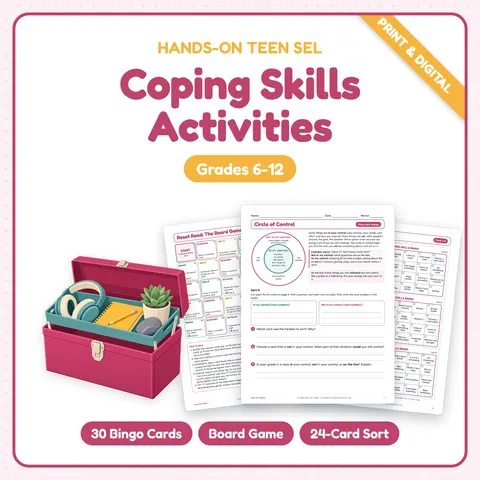
Coping Skills Activities covers the circle of control with a 24-card sort, plus four calm breathing patterns, 5-4-3-2-1 grounding, Coping Skills Bingo, the Reset Road board game, scenario task cards and a personal coping plan. Its teacher pages include guidance on what to do if a student shares something serious and when to involve your counselor.
Lesson 4: big problem or small problem?
The classic "size of the problem" lesson can go badly with teens if it sounds like "your feelings are too big." Reframe it: a problem can feel huge and still need only a small action. The question isn't "How big is your feeling?" but "What does this problem need right now?"
Practice with a handful of scenarios: a missing charger, a mean comment in a group chat, a late bus, a friend who says something worrying. For each one, students separate facts from guesses and choose an action: handle it myself, ask for help, or tell an adult right now.
That last category matters most. Make sure students know that some problems always go to an adult, however small they seem.
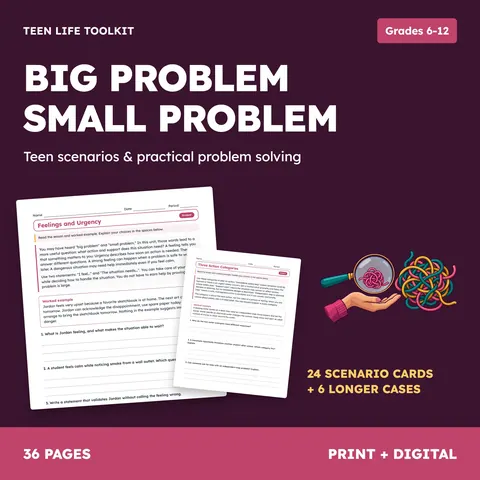
Big Problem vs Small Problem Activities for Teens uses school, community and work scenarios to separate feelings from urgency, check the facts and make a specific help request, with 24 scenario cards and an action and help plan.
Lesson 5: frustration tolerance and trying again
Frustration is a normal part of learning something hard. Teach a simple routine for setbacks: pause, look at the feedback, and choose one change for the next try.
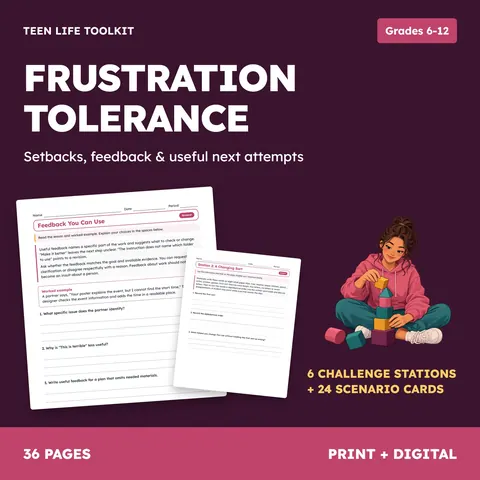
Practice on low-stakes tasks, such as a word sort, a message that needs to be clearer, or a plan that now has to fit into less time. Never set up a task to frustrate students on purpose, and let anyone watch or discuss a fictional example instead of taking part. Frustration Tolerance Activities for Teens includes 24 setback scenario cards, six voluntary challenge stations and a practical retry plan.
Lesson 6: the pause before acting
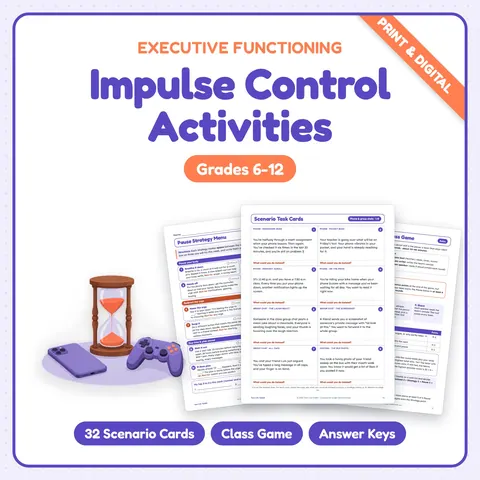
For students who react before they think, teach a simple pause model and practice it on moments teens recognize: a notification mid-lesson, a heated group chat, an online purchase. Impulse Control Activities uses a three-step model (Spark, Space, Steer) with 32 scenario cards, a class game and a one-week tracker.
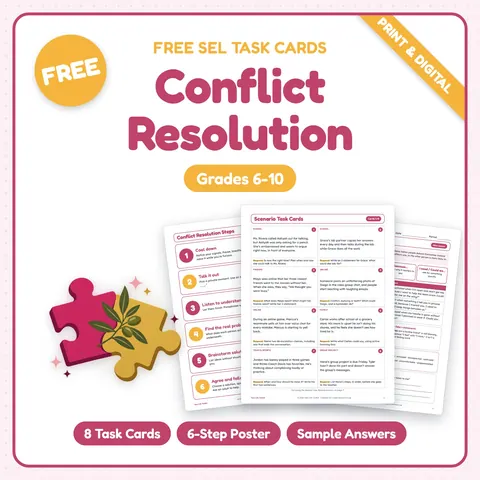
Conflict with other people often sets off big reactions. Our free Conflict Resolution Task Cards for Teens teach six steps for working through a conflict and how to use I-statements, with eight scenarios you can cover in one class period.
Test anxiety: a short unit before testing season
Teach this one or two weeks before state testing or finals. Students learn what the stress response does in the body, that some stress can help while too much gets in the way, and which coping skills they can use before, during and after a test. They finish with a test-day game plan: what I'll do the night before, in the morning, and if I freeze on a question.
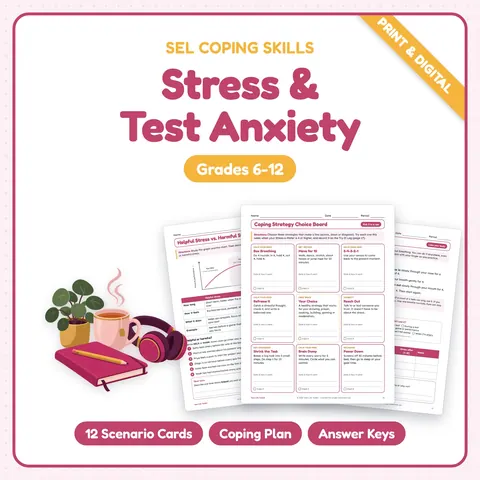
Test Anxiety & Stress Management Lessons for Teens covers stress signals, helpful vs. harmful stress, personal triggers, box breathing, grounding, reframing thinking traps, movement and sleep, and a personal coping plan.
Building a personal coping plan
End the unit with a plan each student writes and keeps. A strong plan includes:
- My warning signs: what I notice in my body and my behavior.
- Two or three strategies that work for me at school, and one or two for home.
- What I can control when things get hard.
- Trusted adults at school and outside school, including the school counselor.
- Crisis help: the 988 Suicide & Crisis Lifeline.
Students decide what to share. Consider checking only that the plan is complete, not reading its content.
When to involve the school counselor
You are teaching skills, not providing therapy, and you don't need to diagnose anything. Bring in your counselor or school mental health staff when:
- a student talks about hurting themselves or someone else, or says someone is hurting them (follow school procedures right away)
- a student's distress is ongoing or getting worse
- a lesson seems to bring up something bigger for a student
- a student asks for more help, or a family raises a concern
A warm handoff, where you walk the student over or introduce them yourself, usually goes better than a referral slip alone.
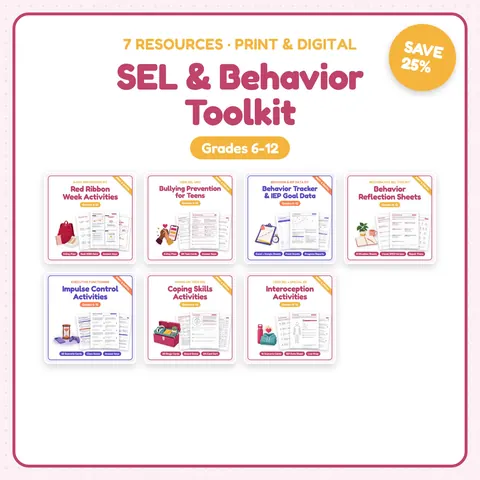
For the coping, interoception and impulse control resources together, the SEL & Behavior Bundle includes them alongside bullying prevention, Red Ribbon Week activities, behavior reflection sheets and behavior and IEP goal tracking.
FAQ
What are good coping skills for teens to use at school?
Quiet, quick strategies work best at school: box breathing or a longer breath out, 5-4-3-2-1 grounding, a short movement or water break, writing down a worry, or asking to see the counselor. Have students try several and pick the two or three that fit them. Agree with students in advance on how they can ask for a break without having to explain in front of the class.
How do I teach coping skills without it feeling babyish?
Use real teen situations, offer choices, and let students rate which strategies they would actually use. Avoid forced sharing and cartoonish visuals, and practice on fictional scenarios first. Games like bingo or a board game help because the practice feels low pressure.
Are coping skills lessons the same as counseling?
No. Classroom coping lessons teach everyday skills for managing normal stress, and they don't diagnose or treat anything. Students with ongoing distress or safety concerns need your school counselor or mental health staff. Anyone in crisis can call or text the 988 Suicide & Crisis Lifeline.