Entrepreneurship Project
Start a Business Simulation · Middle & High School
- Grades
- Grades 7–12
- Formats
- Google Slides, PDF, PowerPoint
- Pages
- 32
- Answer keys
- Included
Opens our store on Teachers Pay Teachers, where you can see the full preview and buy.
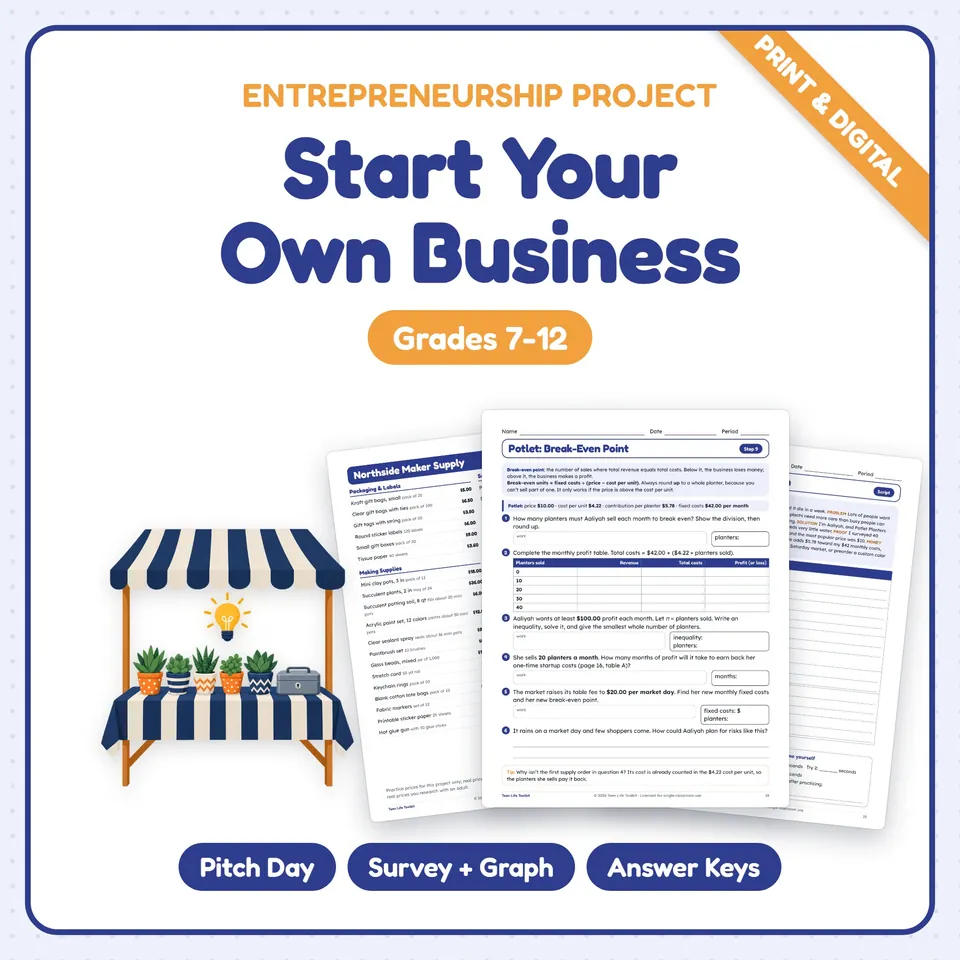
Students invent a business that solves a real problem, then take it all the way to Pitch Day! This no-prep entrepreneurship project for middle and high school walks students through 14 real start-a-business steps: a market-research survey, target customer, competitors, startup costs, pricing, contribution per unit, break-even math, branding, marketing, a one-page business plan and a 60-second pitch. Worked examples from a fictional teen business, Potlet Planters, model the survey, competitor comparison, business math and pitch, so the math is clear and checkable.
What's included
- Teacher guide with 10-day pacing, materials and differentiation (support, on level, challenge)
- Standards page (Common Core math, Speaking & Listening, and the National Standards for Personal Financial Education: Earning Income) with contents
- Student mission, 14-step roadmap and Safe & Smart business rules
- Business Words: 22 key terms, money formulas and a warm-up
- Step 1: Think Like an Entrepreneur: 8-trait self-rating, risks and rewards, setback scenarios
- Step 2: Problem hunt organizer
- Step 3: Idea brainstorm, idea bank and idea scorecard
- Step 4: Write a fair survey (fix-the-question practice), 40 cut-apart survey response slips (simulated practice data), a tally and bar graph page, and My Survey Results
- Step 5: Target customer profile
- Step 6: Competitor comparison with a worked example
- Northside Maker Supply: a fictional supplier price list with 40 items, including monthly fees
- Steps 7-9 with Potlet Planters (the worked example): startup and monthly costs, cost per unit, markup pricing, contribution per unit, contribution margin (before fixed costs), break-even point, a profit table and a profit-goal inequality
- My Money Plan for each student's own business
- Step 10: Build your brand (name check, logo sketches, slogan, colors)
- Step 11: Marketing plan (4 Ps, promotion menu, budget, launch plan)
- Step 12: One-page business plan
- Step 13: 60-second pitch script with a sample pitch
- Pitch Day peer feedback forms
- Step 14: Reflection
- 4 exit tickets
- 16-question vocabulary check
- 24-point project rubric
- Answer keys plus what to look for on open-ended pages
How to use it
Use it as a 10-day unit in business, CTE, career readiness, financial literacy, applied math or advisory, or as an end-of-year project. Print and go: just cut the survey slips (optional) and exit tickets. Students plan a business; the Safe & Smart rules remind them that a real teen business needs a parent or guardian involved and that school and local rules may apply.
Skills practiced
Problem solvingmarket research and surveyspercents and bar graphssamplingstartup and monthly costspricing and markupsprofit and break-evenbranding and marketingpublic speakingpeer feedback