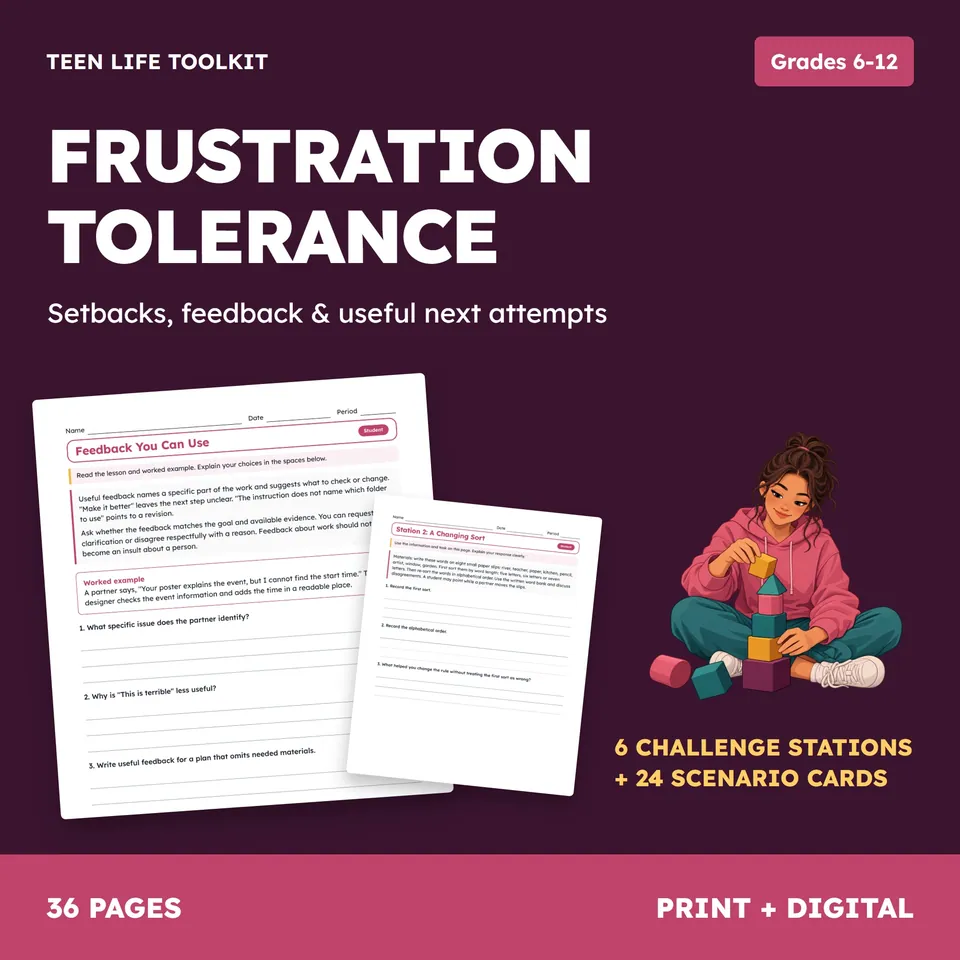
Frustration Tolerance Activities for Teens
Setbacks, Mistakes & Trying Again
- Grades
- Grades 6–12
- Formats
- Google Slides, PDF, PowerPoint
- Pages
- 36
- Answer keys
- Included
Opens our store on Teachers Pay Teachers, where you can see the full preview and buy.
Help teens turn a setback into information they can use for another attempt. These Frustration Tolerance activities combine short lessons, scenario cards and voluntary challenge stations to practice a comfortable pause, specific feedback, a matched support and a concrete revision. Clear examples and reflection prompts help students identify a useful change in the work and explain the support they chose.
What's included
- Teacher guide with a 6-session sequence, materials and differentiation: support, on level and challenge
- Printed standards/skill connections and page-by-page contents
- 4 lessons on setbacks, a comfortable pause, useful feedback and choosing a support
- 24 setback scenario cards with 2 recording sheets
- 6 challenge stations: a paper support, changing word sort, clearer message, revised display, useful edit and a plan with less time
- 2 error-analysis activities covering an error in the work and an error in the directions
- Feedback role-play and a comparison of two supports
- Practical Retry Plan and a short practice log
- Final next-attempt check and a transfer case about mixed feedback
- Complete answer keys and model responses, plus a retry and feedback rubric
How to use it
Use in SEL, life skills, advisory, school counseling or special education, as 6 sessions or a small selection of stations with guided discussion. Low prep: print selected pages, cut the 24 scenario cards and prepare scrap paper, pencils and the word slips described in the sorting station. The stations include observation, pointing, typing or partner options; participation is voluntary, and a fictional discussion can replace a task that is uncomfortable. Do not deliberately create distress to teach the skill. This is classroom practice, not a clinical intervention or a guarantee of emotional change.
Skills practiced
Frustration awarenessSelf-managementFlexible thinkingUsing feedbackError identificationProblem solvingSupport selectionRetry planning