Media Literacy: Spot Fake News & AI Images
Lateral Reading & Source Evaluation
- Grades
- Grades 7–12
- Formats
- Google Slides, PDF, PowerPoint
- Pages
- 26
- Answer keys
- Included
Opens our store on Teachers Pay Teachers, where you can see the full preview and buy.
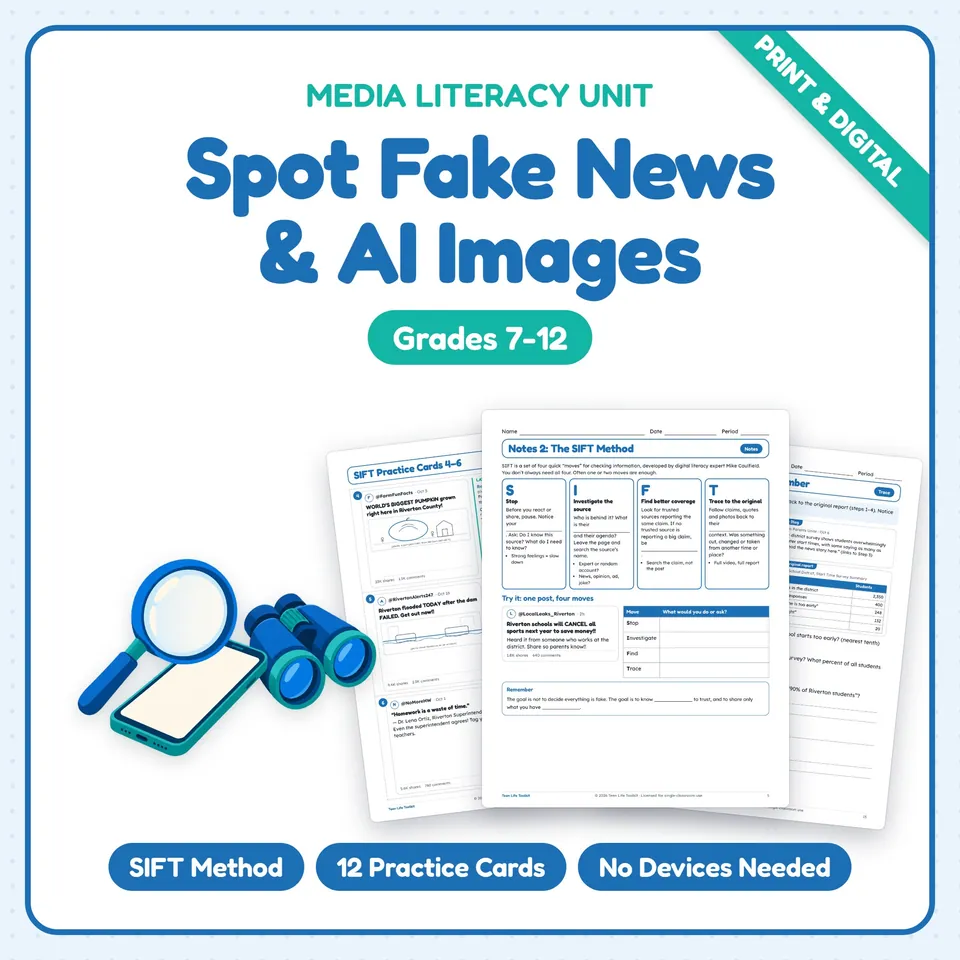
Teach students to spot fake news and AI images with a routine they can use every time they scroll. In this media literacy unit, students learn the SIFT method (Stop, Investigate the source, Find better coverage, Trace claims), practice lateral reading, evaluate sources for authority, purpose and evidence, and learn why visual clues alone can't prove an image is AI-generated or edited. Everything works on paper: each practice card comes with simulated lateral reading results.
What's included
- Teacher guide with 5-day pacing, materials and differentiation (support, on level, challenge)
- Standards page (Common Core RI and W, ISTE Knowledge Constructor and Digital Citizen)
- 5 pages of guided notes: misinformation vs. disinformation, SIFT, lateral reading & source evaluation, AI and edited images, emotional headlines
- 12 SIFT practice cards: fictional posts, texts and articles, each with simulated lateral reading results
- SIFT log (recording sheet)
- Source comparison: a news article, an advocacy blog and a video caption on the same topic
- Claim tracing: follow a viral number back to the original survey
- Image detective: 6 zoomed-in clue sketches + why clues aren't proof
- Headline lab: rate emotional pull, name the trick, rewrite headlines
- Fact-check report template with 20-point rubric and peer review
- 2-page quiz (multiple choice + short answer)
- Complete answer keys explaining the deciding SIFT move for every card
How to use it
Use it over 4-5 class periods in ELA, media literacy, library, social studies, computer applications, advisory or homeroom. No devices are needed, but the fact-check report can also be done with real online research.
Skills practiced
SIFTlateral readingevaluating sourcestracing claims and quotesreverse image searchspotting AI-generated and edited imagesrecognizing emotional headlineswriting a fact-check