Life skills and special educationSeasonal and holidays
Veterans Day Activities for Middle & High School
Reading & Primary Sources
- Grades
- Grades 6–12
- Formats
- Google Slides, PDF, PowerPoint
- Pages
- 30
- Answer keys
- Included
Opens our store on Teachers Pay Teachers, where you can see the full preview and buy.
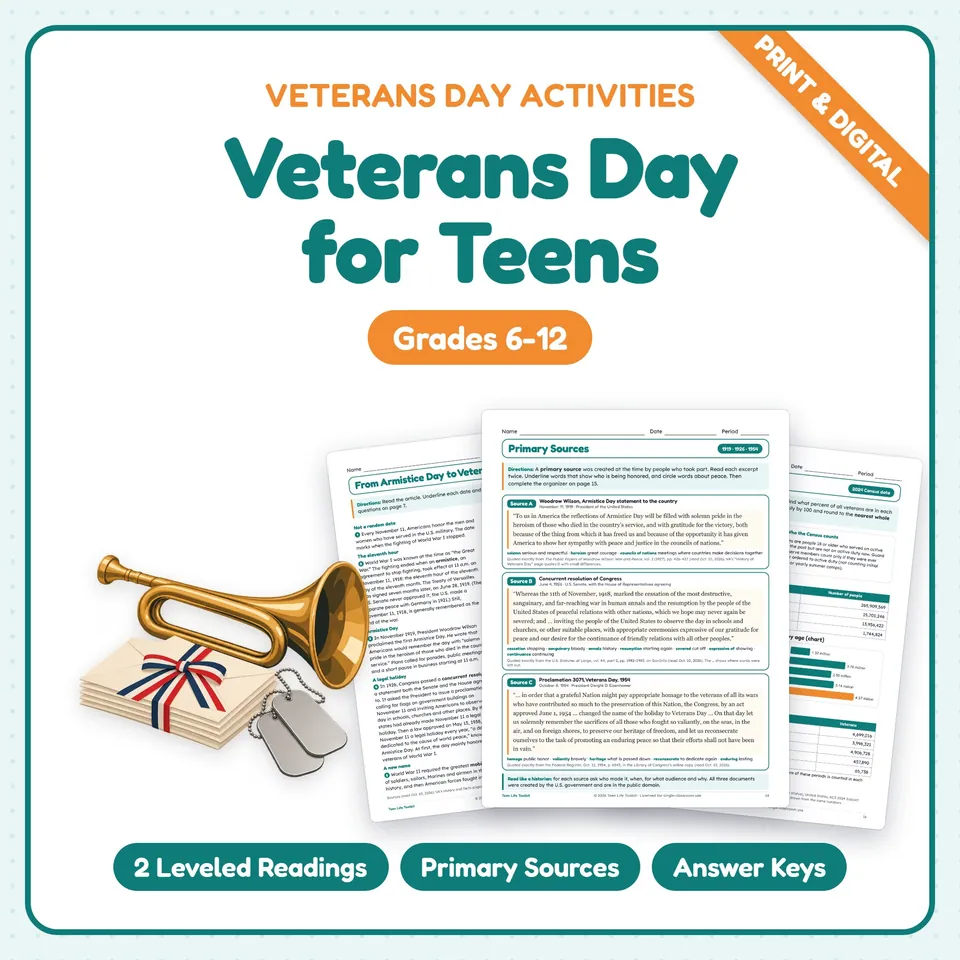
Teach Veterans Day at a real middle and high school level. These Veterans Day activities take grades 6-12 from the 1918 armistice to today with two leveled readings, three short primary sources (Wilson 1919, Congress 1926, Eisenhower 1954), a 12-card timeline, the six military branches plus the Guard and Reserve, and a data activity built on 2024 U.S. Census Bureau veteran numbers (the latest released as of October 2026). Then students connect with a real person through a respectful interview-a-veteran project (with an option for students who have no veteran to interview) and a thank-you letter. Every fact is checked against official sources (VA, Defense.gov, the U.S. Statutes at Large, the Federal Register and the Census Bureau), and the tone is respectful and non-political.
What's included
- Teacher guide with 5-session pacing, learning goals, materials and a 1-2 week project plan
- Teaching notes: differentiation (support, on level, challenge), a teaching-with-care note for students with deployed, injured or deceased family members, interview safety and permission, and every source with the date it was read
- Standards page (Common Core RH, WHST and 6.RP) with contents
- Veterans Day words: 12 words with definitions + 12 practice sentences
- Reading A (on level): From Armistice Day to Veterans Day, a full-page history in 8 short sections + 8 text-dependent questions
- Reading B (supported): The Story of Veterans Day, with headings, a picture timeline and a glossary + 6 multiple-choice questions, a matching task and 2 sentence frames
- Three days of honor: Veterans Day vs. Memorial Day vs. Armed Forces Day, a 10-statement sort and a Remembrance Day "around the world" sidebar
- Who serves? The six branches (Army, Marine Corps, Navy, Air Force, Space Force, Coast Guard), the Guard and Reserve, who counts as a veteran, and 6 branch clues
- Timeline: 12 cut-apart event cards (1918-1978) + recording sheet with year questions
- Primary sources: short excerpts quoted exactly from the original documents: Wilson's 1919 Armistice Day statement, the 1926 concurrent resolution of Congress and Eisenhower's 1954 Veterans Day proclamation, each with a glossary
- Source analysis organizer (creator and date, type, audience, purpose, key phrase, who is honored, peace) + 3 analysis questions
- Veterans by the numbers: 2024 American Community Survey data (about 15.7 million veterans) with an age chart, a percent table and 9 data questions
- Interview a veteran: project guide with permission steps, a sample script, respectful interviewing tips, topics to avoid and Option B (research a veteran's story)
- 24-question interview bank, interview plan, permission checklist and question order, plus a notes page
- Veteran profile write-up page + 16-point rubric and reflection
- Thank-you letter guide with dos and don'ts, a model letter and a planner + a fold-and-write thank-you card
- 14-question quiz (12 multiple choice + 2 short answer)
- 8 exit tickets
- Complete answer keys, including model answers for the organizer, every data calculation and what a strong answer includes for every open question
How to use it
Use it the week of Veterans Day (November 11, a Wednesday in 2026) in social studies, U.S. history, ELA, advisory or homeroom. Run it as a 5-session mini-unit or pick the pages you need: a reading plus the three-days page makes a strong single lesson. Low prep: print, then cut apart the timeline cards and the thank-you card. Send the project guide home a week early so students can arrange an interview. There is no graphic war content, and students who prefer not to interview anyone have an equal-credit research option.
Skills practiced
Reading informational textprimary source analysissourcing and datingchronologycomparing holidaysmilitary branchespercentages from real datainterviewingrespectful communicationletter writing