Life skills and special educationSeasonal and holidays
Holidays Around the World
Winter Reading & Activities · Middle & High School
- Grades
- Grades 6–12
- Formats
- Google Slides, PDF, PowerPoint
- Pages
- 40
- Answer keys
- Included
Opens our store on Teachers Pay Teachers, where you can see the full preview and buy.
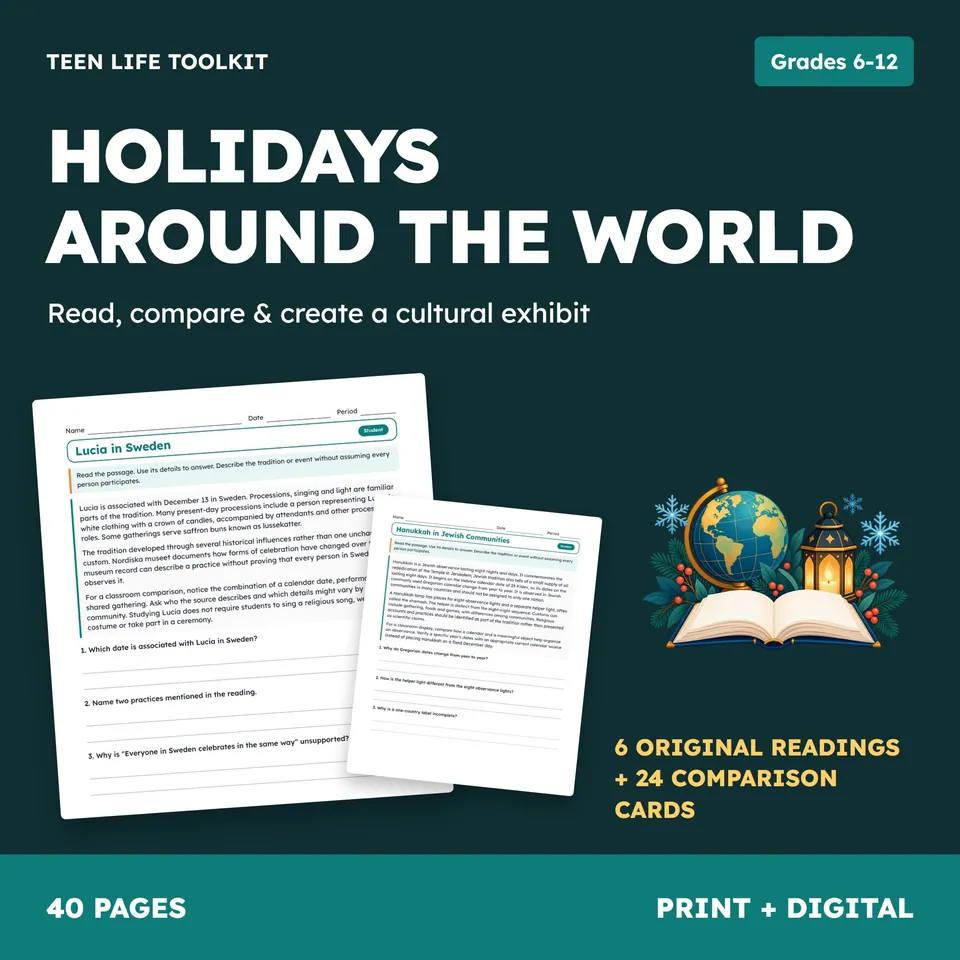
Give middle and high school students a winter reading unit that compares evidence while keeping each tradition's context clear. These Holidays Around the World activities use original readings, comparison tasks and a partner jigsaw to explore Lucia, Las Posadas, Hanukkah, Kwanzaa, New Year traditions in Japan and the December solstice. Students bring the reading together in a small, source-labeled classroom exhibit.
What's included
- Teacher guide with a 6-session sequence, materials and differentiation: support, on level and challenge
- Printed standards/skill connections and page-by-page contents
- 6 original informational readings with comprehension questions: Lucia, Las Posadas, Hanukkah, Kwanzaa, Japan New Year and the December solstice
- 6 comparison activities addressing gatherings, meaningful objects, calendar patterns, seasons, history and variation
- 24 winter-comparison discussion cards with 2 recording sheets
- Geography/hemisphere and calendar-pattern investigations
- Exhibit planner, caption draft/check and a source-check page for an extension
- Partner A and B jigsaw references with a shared six-topic response grid
- Final winter-reading check and an exhibit-accuracy revision case
- Complete answer keys and model responses, plus a cultural-exhibit rubric
How to use it
Use in middle or high school informational reading, social studies or supported cross-curricular lessons. Follow the 6-session sequence: begin the jigsaw before sharing all readings, giving A Lucia/Las Posadas/Kwanzaa and B Hanukkah/Japan New Year/solstice, then exchange using the shared response grid. Continue with comparisons, discussion and an exhibit. Low prep: print the assigned partner sets and cut the 24 discussion cards if using stations. Keep the work academic, allow students to pass on personal sharing and do not require religious participation. Distinguish community examples from universal claims and verify current-year calendar details for extensions.
Skills practiced
Informational readingCentral ideasText evidenceComparing contextsCalendar reasoningGeographic scopeSource checkingExhibit writing