How to Teach Budgeting to High School Students: A 1-Week Plan
Budgeting sticks with high school students when they work with a realistic income, pay for needs first and see the trade-offs in numbers they can check. Here is a five-day plan that moves from needs vs wants to a first budget, then paychecks, bills and a closing project. Every day works with materials you make yourself, and we point out free and paid resources where they save time.
The one-week budgeting plan at a glance
- Day 1: Needs vs wants (partner card sort and discussion)
- Day 2: Build a first budget from a realistic take-home income
- Day 3: Where the paycheck goes: gross pay, deductions and net pay
- Day 4: Fixed vs variable costs, and paying bills on time
- Day 5: A real-world project students hand in or present
One ground rule for the whole week: use fictional people and incomes. No student should have to share what their family earns or spends.
Day 1: Needs vs wants
Warm-up (5 minutes). Put three items on the board: a winter coat, a pair of brand-name sneakers and a phone plan. Ask "need or want?" and take a quick vote. The phone plan usually starts a useful argument.
Card sort (20 minutes). Pairs sort 20 to 24 everyday items into three piles: need, want and "it depends." Every card in the "it depends" pile needs a written reason.
Discussion (10 minutes). Push on two ideas:
- Situation changes the answer. A car can be a want for a student on a bus route and a need for someone who works a late shift across town.
- Many needs have a want part. You need shoes. You want the expensive ones.
Close (10 minutes). Give a fictional teen a small monthly amount and a list of costs. Students pay the needs first, then decide what is left for wants.
When a student insists everything is a need, ask: "What actually happens if you go a month without it?"
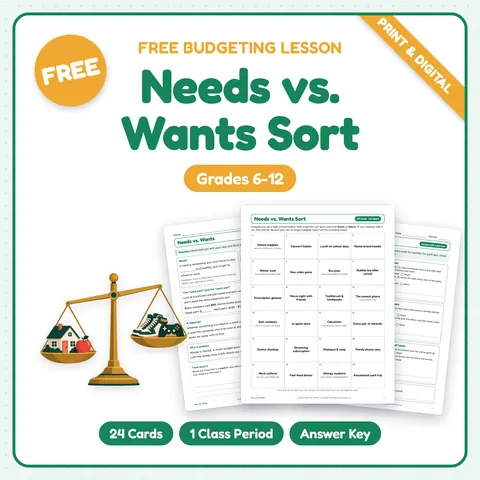
If you would rather not make the cards yourself, our FREE Needs vs Wants Sort is built for this period: 24 cut-apart sort cards, a recording sheet, an "It Depends!" discussion with six pairs of real-life situations, a budget mini-scenario called Jordan's $150 Month and an exit ticket.
Day 2: Build a first budget with a realistic income
The most common mistake is handing students a big round number. A budget only teaches something when the money runs out before the wish list does.
Set it up. Write six to eight entry-level job cards, each with a monthly take-home amount. Then make a short "cost-of-living menu" with two or three options for rent, transportation, phone, groceries and fun. Students pick from each category and make it balance.
Teach the 50/30/20 guideline. It is a widely used rule of thumb: roughly 50% of take-home pay for needs, 30% for wants and 20% for savings and paying down debt. On $2,000 a month, that is $1,000, $600 and $400. Present it as a starting point, not a law. On an entry-level income, needs often take more than half, and noticing that is a useful lesson in itself.
Then make it zero-based. In a zero-based budget, every dollar gets a job until income minus spending equals zero. Savings counts as a job.
What students produce: a one-page budget showing income, each category, the percent of income for each and a final balance of $0.
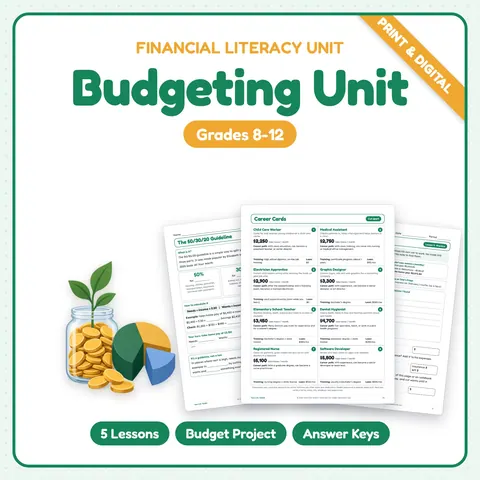
Our Budgeting Activities for High School unit covers this day in depth, with five guided-notes lessons (including the 50/30/20 guideline and zero-based budgeting), a Fix the Broken Budget challenge, four case studies and a Build Your First Budget project with eight career cards and a cost-of-living menu. The full unit is paced for 8 to 9 days, so for this week, pull the 50/30/20 lesson for Day 2 and save the project for Day 5.
Day 3: Paychecks, deductions and gross vs net pay
Students tend to assume that 20 hours at $15 an hour means $300 in their pocket. A pay stub corrects that fast.
Teach four terms:
- Gross pay: hours times the hourly rate, plus overtime (for many hourly jobs, time and a half for hours over 40 in a week).
- Deductions: federal and state income tax withholding, plus Social Security (6.2%) and Medicare (1.45%), together known as FICA.
- Pre-tax deductions: things like a 401(k) or health insurance, taken out before some taxes.
- Net pay: what actually lands in the bank account.
Board example. On $500 of gross pay, Social Security is $500 × 0.062 = $31.00 and Medicare is $500 × 0.0145 = $7.25. Income tax withholding depends on each person's W-4 and state, so give students that number and keep their energy on the math they can check.
Connect it to Day 2. The take-home figure they budgeted with yesterday was net pay. Ask what the gross pay would have needed to be.
Finish with "find the error." Give students a pay stub with a few planted mistakes. Checking a pay stub is a real skill to take into a first job.
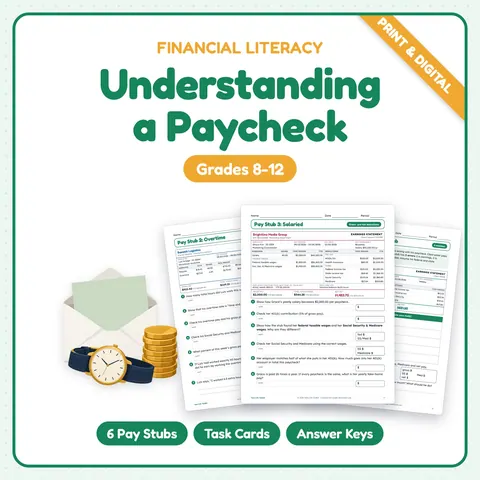
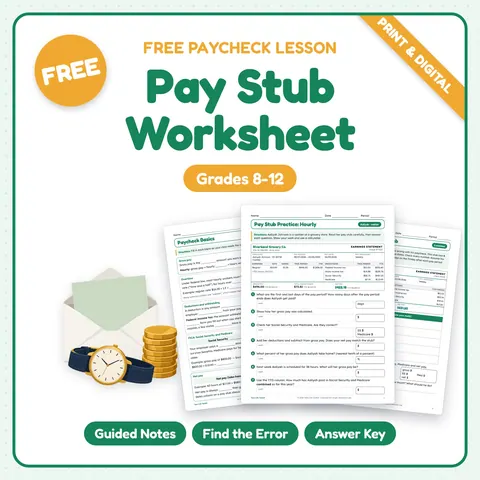
Our FREE Pay Stub Worksheet is a ready 60-minute lesson: guided notes on gross pay, overtime, FICA and net pay, a realistic hourly cashier pay stub with seven questions, and a lifeguard's pay stub with five mistakes to find and fix. For more depth, Understanding a Paycheck runs over five periods with four pay stubs (hourly, overtime, salaried and tipped), timesheet math and an hourly vs salary job offer comparison.
Day 4: Fixed vs variable costs and paying bills
Sort the costs (15 minutes). Give students 15 expenses to sort into three groups:
- Fixed: the same every month (rent, a phone plan, a car payment)
- Variable: changes month to month (groceries, gas, electricity)
- Periodic: not monthly, so easy to forget (a yearly subscription, car registration, gifts)
Periodic costs are the ones that break budgets. Show students how to set aside a twelfth each month: a $120 yearly subscription is $10 a month.
Bill calendar challenge (25 minutes). First, have pairs label the amount due, due date and late fee on one sample bill. Then give each pair five or six bills with due dates and a paycheck that arrives on the 1st and the 15th. They decide which paycheck covers which bill so nothing is late. Finish by asking: "What if rent is due on the 1st but you get paid on the 5th?"
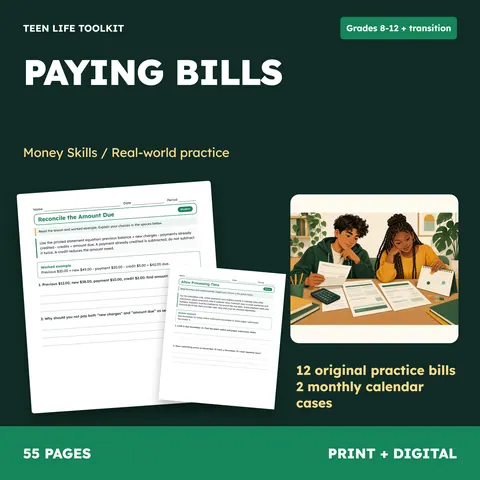
Paying Bills Life Skills turns this day into a fictional household payment desk: students read 12 original practice bills, check payments, organize due dates on two monthly calendar cases and work through 12 billing problem cards about mismatched records.
Day 5: A real-world budgeting project
Pick the option that fits your class and time.
Option A: Rebuild the Day 2 budget (no materials needed). Students take their Day 2 budget, put each bill on a payment calendar like the one from Day 4, then draw a "life happens" card: a car repair, an extra shift, a friend's birthday. They rebalance and explain the change in writing.
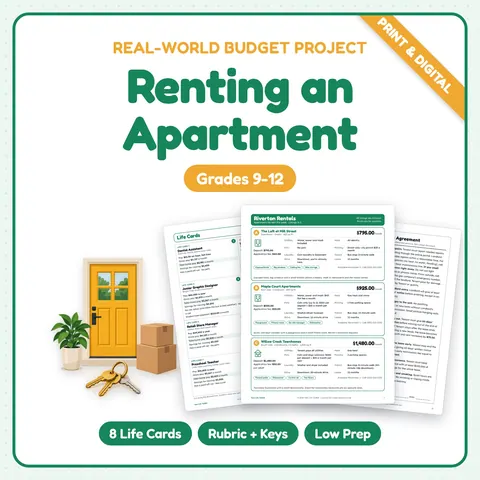
Option B: A move-out project. In the Renting an Apartment Project, students draw a life card with a first job and paycheck, shop six apartment listings, apply the 30% rent guideline, estimate utilities, add up move-in costs, read a one-page lease and defend their choice. It runs six days, so it works best as the next unit or an end-of-semester capstone.
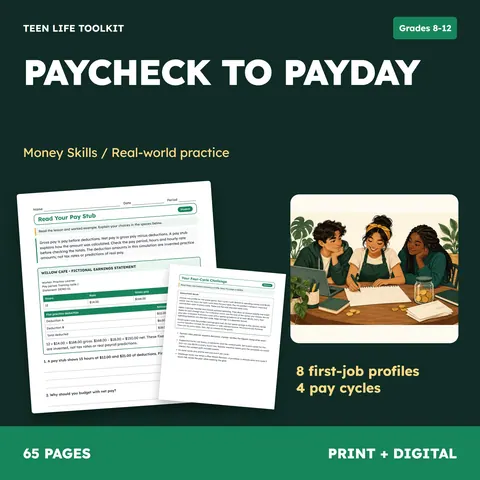
Option C: A pay-cycle simulation. In Paycheck to Payday, students take a fictional first job through four pay cycles, responding to surprise event cards without running out of money.
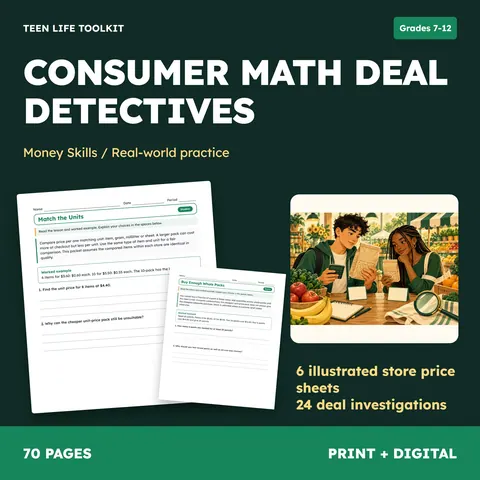
Option D: Smart shopping. For a younger or mixed group, Consumer Math Deal Detectives has students investigate six fictional store price sheets, test tempting offers and recommend purchases that fit a customer's needs and budget.
Whatever you choose, students produce: a balanced budget, a simple graph of where the money goes and a short reflection answering "What did you give up, and why?" Grade on four things: the math balances, needs come first, savings is included and the reasoning is explained.
Adjusting the week for different learners
- Support: calculators, rounded numbers, five categories instead of ten, a partly filled budget and sentence starters.
- Challenge: a lower-income card, a student loan payment, or an emergency fund goal (a commonly cited target is three to six months of essential expenses).
- Life skills classes: fewer numbers per page and more partner talk.
If you teach a full personal finance course, our Financial Literacy Bundle groups 12 resources, including the budgeting unit, Understanding a Paycheck and the Renting an Apartment Project, plus credit, banking, compound interest, buying a car, taxes, scams and an escape room. Paycheck to Payday, Paying Bills and Deal Detectives are sold separately.
FAQ
How long should a budgeting unit be in high school?
Five days covers the essentials. A full unit with notes, case studies and a longer project usually runs closer to two weeks. If you only have one or two periods, prioritize needs vs wants and a first budget built on a realistic take-home income.
Is the 50/30/20 rule realistic for teenagers?
It is a helpful starting point rather than a rule. On an entry-level income, needs often take more than 50%, especially rent. Let students try it, see where it breaks and explain what they would change, which is a more useful conversation than hitting the percentages exactly.
How do I teach budgeting without students sharing family finances?
Use fictional characters, career cards or a pretend weekly allowance, and let students choose who they budget for. Avoid asking what their family pays for rent or groceries. A cost-of-living menu with practice prices gives everyone the same information to work from.