Thanksgiving Math Activities for Middle and High School
The best Thanksgiving math activities for middle school use the meal itself as the problem: a fixed budget, a grocery ad, a recipe that serves the wrong number of people and a turkey that has to thaw in time. Below are six ideas you can run with a printed ad and a calculator, plus how to fit them into the short, unpredictable days before the break. Thanksgiving 2026 falls on Thursday, November 26.
Why real-world math works the week before Thanksgiving
Attention is thin that week, attendance is patchy and schedules change at short notice. Tasks with a clear goal ("feed eight people for $120") hold up better than a worksheet of unrelated problems, because students can see why each step matters.
These activities also practice skills your students already have: ratios, unit rates, percents and multiplying fractions. You are not teaching something new on a day when part of the class might be missing. You are giving familiar math a reason to exist.
Six Thanksgiving math activities students can actually do
1. Plan a Thanksgiving dinner on a budget
Give groups a budget, a guest count and a grocery ad. Set menu requirements (a main dish, two sides, a dessert and a drink) and add one guest with a food allergy so students have to read labels and plan around it.
What students produce: an itemized shopping list with a subtotal, coupons, sales tax and a final total, plus one sentence proving they stayed under budget.
When it goes wrong: some groups spend half the budget on dessert. Let them. The moment they realize there is no money left for the turkey is the lesson. Give them ten minutes to revise and explain what they changed.
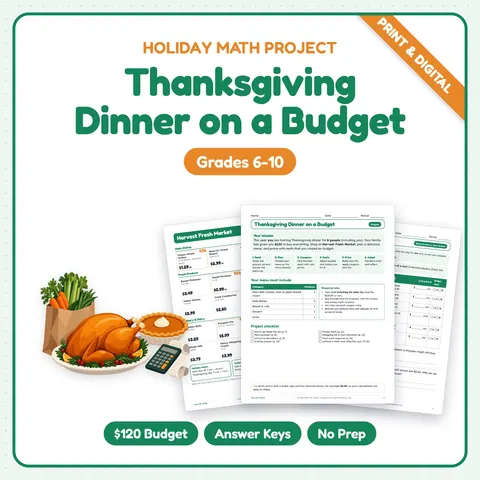
Our Thanksgiving Dinner on a Budget project is built around this activity. Students plan dinner for 8 people on a $120 budget using a two-page "Harvest Fresh Market" grocery ad with 40+ items, sale prices and digital coupons. It also includes a menu planner with a guest allergy check, a unit price showdown, recipe scaling, turkey math, a shopping list and cost calculator with 6% sales tax, eight Holiday Twist Cards and food waste percent problems. The teacher guide has 3-day pacing.
2. Unit price showdowns
Put two versions of the same item side by side, such as name brand and store brand cranberry sauce. Students divide price by quantity to find the cost per ounce.
A quick board example: 24 ounces for $3.60 is $0.15 per ounce. 32 ounces for $4.48 is $0.14 per ounce. The bigger package wins here, but not always, so include at least one pair where the smaller size is the better buy.
Watch for mixed units. If one can is listed in ounces and the other in pounds, students have to convert first (16 ounces in a pound). Then push the thinking further: a cheaper price per ounce is not a better deal if half of it ends up in the trash.
3. Scaling recipes with fractions
Recipes rarely serve the number of people you have. A stuffing recipe that serves 6, made for 15 guests, needs a scale factor of 15 ÷ 6 = 5/2. So 2/3 cup of broth becomes 2/3 × 5/2 = 10/6, or 1 2/3 cups.
Have students scale one recipe up and one down. Then add the real-kitchen problem: you cannot buy 1.5 eggs or 2.3 sticks of butter. Students round up to whole items or whole packages and explain why.
In a FACS or life skills room, bring in measuring cups and let students check that 1 2/3 cups actually looks right.
4. Turkey math
This one has a built-in deadline, which makes it good backward-planning practice.
- How big a turkey? Give students a planning figure. Many guides use about 1 to 1½ pounds of whole turkey per person.
- How much will it cost? Weight × price per pound.
- When does it go in the fridge? USDA guidance for thawing in the refrigerator is roughly 24 hours for every 4 to 5 pounds. A 16-pound turkey at 4 pounds a day needs about 4 days, so it should be in the fridge by Sunday for a Thursday dinner.
- When is it done? The USDA safe minimum internal temperature for poultry is 165°F.
Ask why planning with 4 pounds a day is safer than planning with 5. It is a good conversation about building in a margin.
5. Sales tax and coupons
Give students a receipt subtotal and a practice tax rate. On a $96.50 order with 6% tax, the tax is $96.50 × 0.06 = $5.79, for a total of $102.29.
Two accuracy notes worth sharing with students. Many states tax groceries at a lower rate or not at all, so treat the rate as a practice number. And decide as a class whether coupons come off before tax, then stick with it, because real rules vary by state and by coupon type.
6. Leftovers and food-waste percents
After the meal, students work out what share of the food was eaten and what was thrown away. If a family cooked 14 pounds of food and threw away 3.5 pounds, they wasted 3.5 ÷ 14 = 25%.
Then ask them to change the plan (fewer rolls, a smaller turkey, a leftovers menu for Friday) and recalculate. Percent decrease, reasoning and a practical habit, all in one task.
How to run Thanksgiving math in a short week
Schools handle the break differently. Some close for the whole week, so "the week before" is November 16 to 20. Others have two or three days before closing on Wednesday or Thursday. Either way, plan for fewer days than you think.
A three-day plan:
- Day 1: Read the ad, plan the menu and estimate the cost.
- Day 2: Unit prices, recipe scaling and turkey math.
- Day 3: Final shopping list, tax, one twist card and a short reflection.
Make every page stand alone. Keep work in a group folder so an absent student can rejoin the next day without being lost.
Use twist cards for fast finishers. Surprise guests, a sold-out item or a sudden budget cut keep early finishers working and test whether their plan holds up.
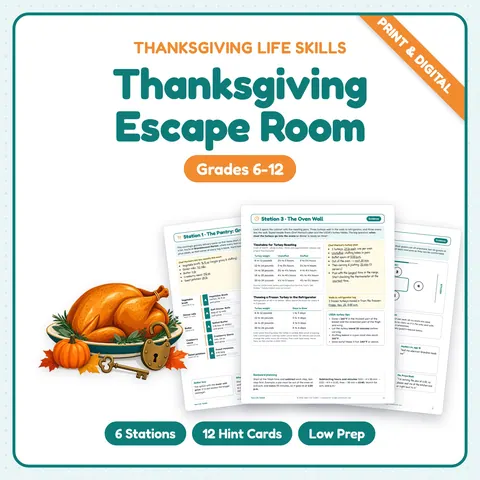
Save a game for the last day. If the final day before break is short and loud, a team activity often works better than finishing a project. Our Thanksgiving Escape Room puts teams in charge of a free community dinner for 60 neighbors. Six locked stations cover a grocery budget, scaling a recipe from 8 to 60 servings, a cooking timeline using USDA tables, food safety, a seating chart logic puzzle and a volunteer schedule. Teams of 3 to 4 work through it in one 45 to 60 minute period (or two shorter ones), and no lock boxes are needed.
Differentiating Thanksgiving math
Support: fewer menu items, prices rounded to the nearest dollar, calculators for everyone, fraction strips for recipe scaling, a worked example at each station and a partner.
On level: the full menu, exact prices and a written justification.
Challenge: a smaller budget or more guests, cost per serving for each dish, or a recommendation comparing two complete menus.
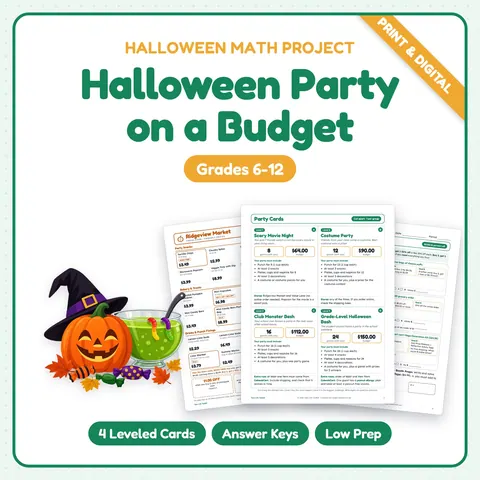
Different numbers for different groups. Giving each group its own guest count and budget lets you level the work quietly. Our Halloween Party on a Budget project does this with four leveled party cards for 8 to 24 guests, and the skills (unit prices, deals, scaling a punch recipe, sales tax) carry straight into November. If you are reading this before Halloween, it is a good warm-up for the Thanksgiving project.
Keep it inclusive
Not every family celebrates Thanksgiving, and some students live with real food insecurity. Keep budgets fictional, never ask what a student's family spends, and offer a neutral frame such as a community dinner or a harvest meal for friends. The Thanksgiving Escape Room's teacher guide includes a note for classes with students who don't celebrate Thanksgiving.
After Thanksgiving: keep the money math going
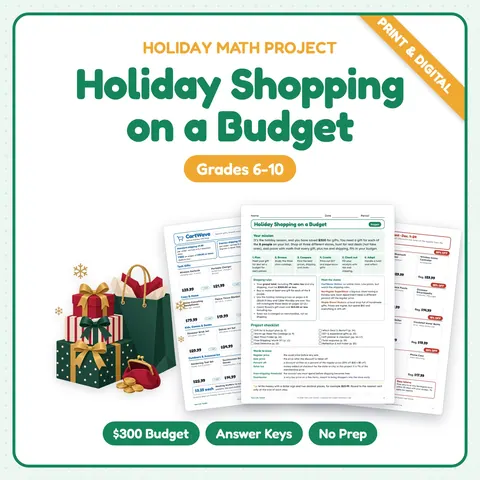
The Monday after Thanksgiving is a natural time to talk about sales. Holiday Shopping on a Budget gives students $300 and a gift list of 8 people, three store catalogs, percent discounts, sales tax and free-shipping rules, plus a Black Friday doorbuster ad and a Cyber Monday email ad to test whether the deals are real.
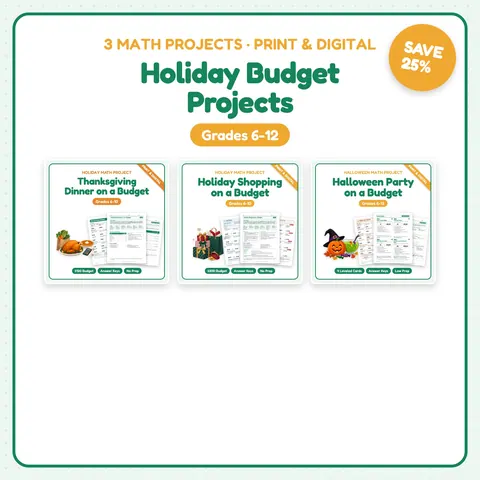
If you like running a budget project each season, the Holiday Budget Projects Bundle includes the Halloween, Thanksgiving and holiday shopping projects.
FAQ
What math skills do Thanksgiving activities cover in middle school?
Mostly ratios and unit rates (unit prices, price per pound), percents (sales tax, discounts, food waste), multiplying fractions (scaling recipes) and elapsed time (thawing and cooking schedules). These line up with grade 6 and 7 ratio and percent work, so they make strong review without new content in a short week.
How long does a Thanksgiving math project take?
A full dinner-budget project usually takes about three class periods. Single activities, such as a unit price showdown or a recipe-scaling page, fit into 20 to 30 minutes. An escape room fits one 45 to 60 minute period.
Can I use Thanksgiving math activities in high school?
Yes. Raise the challenge with a tighter budget, more guests, cost per serving and a written recommendation, or use it in consumer math, FACS or life skills. The food safety and backward-planning parts connect directly to cooking for themselves, which older students are often close to doing.