How to Run a Classroom Escape Room in Middle and High School
A classroom escape room is a set of puzzles that small teams solve in one class period, where each correct answer produces a code that opens the next step. Running one well comes down to five things: puzzles that check real skills, teams of three or four with clear roles, a simple way to check codes, a hint policy you decide in advance and a debrief that turns the game back into learning. Here is how we set them up, with or without lock boxes.
What a classroom escape room is (and isn't)
An escape room is best used for review and practice, not for teaching something brand new. Students need to recognize the skill in each puzzle and apply it under a little time pressure.
Most classroom versions share the same structure:
- A story that gives teams a reason to solve things (a missing paycheck, a lost backpack, a locked supply closet)
- Four to six stations, each with evidence to read and a puzzle that produces a code
- A recording sheet where teams write each code
- A final lock that uses all the earlier codes
Running stations in a fixed order is easiest to manage. If every team has its own copy of each station, there is no crowding.
How to set up a classroom escape room
Build puzzles that produce a code
If you are making your own, each station needs a puzzle whose answer becomes a code. A few reliable formats:
- Number codes: students solve three or four problems, and the answers (or the ones digit of each) become the code.
- Word codes: a matching or sorting task where the letters of the correct answers spell a word.
- Directional codes: students follow directions on a map or floor plan and record each move as up, down, left or right.
- Logic puzzles: a seating chart or schedule with exactly one solution.
Avoid codes built only from multiple-choice letters, which teams can guess faster than they can solve. Computed answers are much harder to guess.
Prep checklist for each team
- One packet or envelope per station, labeled with the station number
- An answer recording sheet
- Pencils, scrap paper and calculators
- A team folder for anything that has to carry over to a second day
For yourself: the answer key on a clipboard, hint cards, a timer you can project and a list of likely wrong codes.
Locks: with boxes, without boxes or digital
Lock boxes. Real combination, word and directional locks on a box or hasp add drama. The downsides are cost, resetting every combination between classes and students spinning dials to guess.
No boxes: envelopes and a Game Master check. Teams bring their recording sheet to you. If the code is right, you initial it and hand over the next envelope. This is the cheapest option, the fastest to reset and the hardest to guess through, because every attempt goes past you.
Digital. A form with answer checking or a slide deck with type-in boxes works for one-to-one devices. Set a rule for wrong attempts, because guessing on a screen is quick.
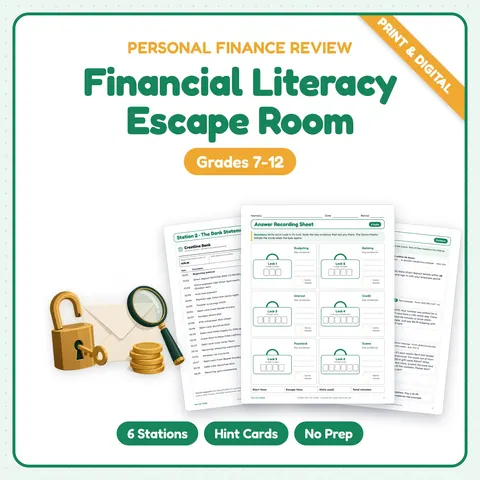
Our Financial Literacy Escape Room is built for the no-box approach. Teams follow the money to find out why 19-year-old Jordan never received his paycheck, working through six stations on budgeting, banking, interest, credit, paychecks and scams. You put each station in an envelope, or staple the packets and initial each lock as teams solve it.
Teams and roles
Teams of three or four work best. With five or more, someone usually drifts off. Set the groups yourself and mix strengths.
Give every student a job:
- Reader: reads the evidence aloud
- Solver: leads the math or reasoning
- Recorder: writes the work and the code
- Checker: confirms the work and is the only person who brings the code to you
Rotate roles at each station so nobody spends the whole period only reading. Having one "checker" per team also keeps the line at your desk short.
Hints: how many and when
Decide your hint rules before the game starts and say them out loud.
- Hint passes: each team gets a fixed number, such as three for the whole game.
- Show your thinking first: a team must show you what they have tried before you give a hint.
- Two levels: the first hint nudges ("Check the units"), and the second is more direct.
- Rescue rule: if a team has been stuck for several minutes, offer a free hint. Ten minutes of being stuck rarely teaches anything.
Time penalties for hints are optional. Leave them out if your class gets anxious about competition.
Timing a 45 to 60 minute escape room
- 5 minutes: story, rules, roles and hint policy
- 35 to 40 minutes: stations (about six minutes each for six stations)
- 10 minutes: debrief and exit ticket
If your periods are short, split it over two days: three stations each day, with everything going into the team folder at the bell.
Fast teams: ask them to write a better hint for the station they found hardest. It keeps them thinking about the content without handing answers to other teams.
Slow teams: near the end, give them one station's code so they can still reach the final lock. Every team should get to finish.
What to do when it goes wrong
- Code guessing: only check codes when the work is on the page. Two wrong attempts at a station earn a hint, not a third guess.
- One student doing everything: roles rotate, and every role initials the recording sheet.
- A close but wrong code: use it diagnostically. A predictable wrong answer usually points to one misconception, such as a forgotten step or a percent read as a whole number.
- Too much noise: only checkers come to your desk, and only one team at a time.
The debrief: where the learning happens
Keep ten minutes for this, even if some teams have not finished. Ask:
- Which station was hardest, and why?
- What did your team do when you got stuck?
- Which skill from today would you use outside school?
Finish with a short exit ticket that has one problem like each station. If time ran out, reveal the remaining codes together so every team "escapes."
Keeping it fair for all learners
- Reward accuracy, not only speed. If the only prize is finishing first, the same students win every time.
- Build in access: read-aloud support, calculators, larger print, pre-taught vocabulary, fewer stations or extra time, following any IEP or 504 plan.
- Think about noise. Some students find escape rooms overwhelming. Offer a quieter spot or a role with less talking.
- Check your theme. Not every student celebrates every holiday, so choose themes that include everyone or offer a neutral framing.
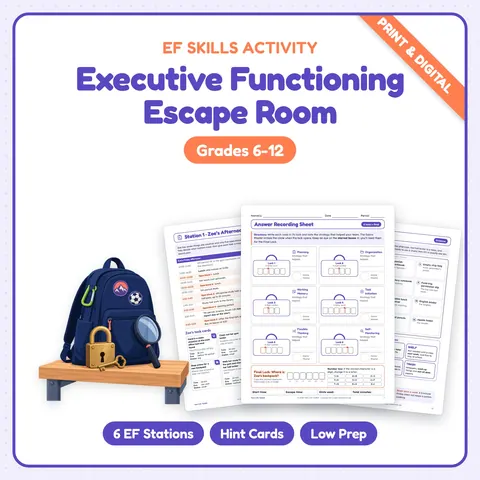
An escape room asks students to plan, stay organized and hold information in mind, which makes it a natural fit for executive functioning practice in advisory and resource rooms. Our Executive Functioning Escape Room has teams help Zoe find her lost backpack before her lab report is due, with six stations that each practice one EF skill. It also includes an "EF in Plain Language" teacher page on how to talk about EF struggles without judgment.
Ready-made escape rooms for middle and high school
If you would rather not build your own, each of ours includes six stations, an answer recording sheet with lock graphics, 12 hint cards (two per station), a debrief with exit tickets, a Certificate of Escape and complete answer keys that list common wrong codes. None of them need lock boxes.
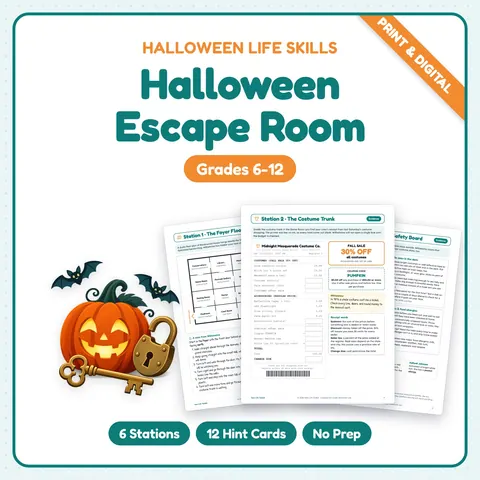
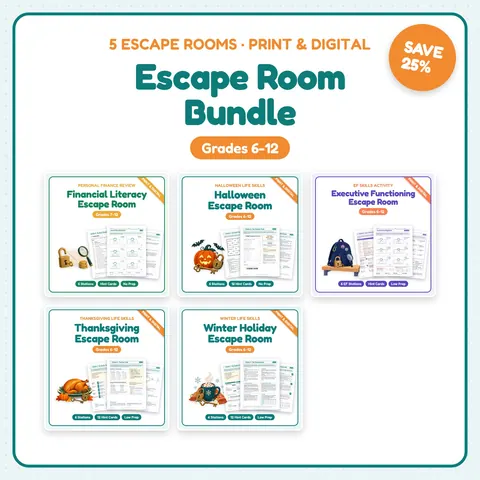
- Halloween Escape Room: teams are locked inside Ravenwood House by a polite but very particular ghost. They read a floor plan, check a costume receipt, scale a punch recipe for 40 guests, plan with a timetable, spot a scam text and make safe Halloween choices. Spooky, never gory.
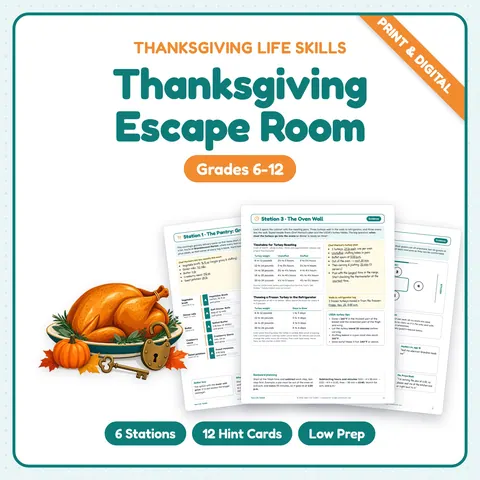
- Thanksgiving Escape Room: teams are the volunteer crew for a free community dinner for 60 neighbors, working through a grocery budget, a recipe for a crowd, a cooking timeline, food safety, a seating chart and a volunteer schedule.
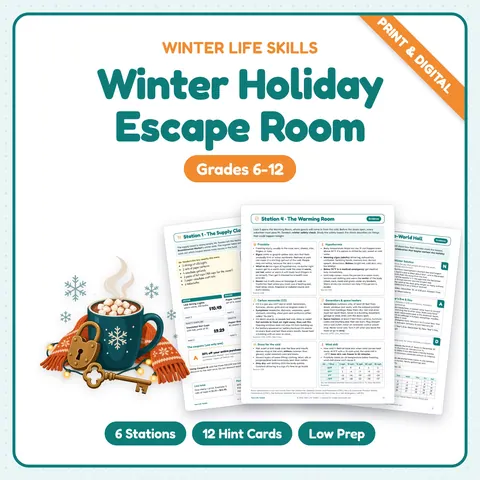
- Winter Holiday Escape Room: teams set up a community center's Winter Festival, with a coupon choice, a hot cocoa recipe for 100, a snow-delay bus problem, a winter safety check, winter celebrations around the world and a gift-swap logic puzzle. Use it in December or right after winter break.
- Financial literacy and executive functioning: the two rooms above work any time of year.
The Escape Room Bundle includes all five, so you have one for October, November and December plus two for any time.
FAQ
Do I need lock boxes for a classroom escape room?
No. Envelopes and a teacher check work well: teams bring their code to you, you initial it if it is right and hand over the next station. This costs next to nothing, resets in minutes and stops students guessing their way through a combination lock.
How long does a classroom escape room take?
Plan for a full 45 to 60 minute period: about 5 minutes to launch, 35 to 40 minutes of puzzles and 10 minutes to debrief. With shorter periods, split the stations across two days and keep each team's work in a folder.
What grades are classroom escape rooms good for?
They work from middle school through high school as long as the puzzles match what students already know. For younger or less confident groups, use fewer stations and more hints. For older students, add multi-step problems and expect written reasoning.