Life Skills Activities for Special Education High School
The best life skills activities for high school special education use the real documents students will meet in the community: menus, store flyers, bus schedules, calendars, signs and forms. Teach one skill at a time with the same document at different levels, practice it out loud, then try it in a real setting and record the data for IEP goals. Below is how we set up each skill, what students produce, and what to do when a lesson stalls.
What makes a life skills activity "functional"?
A functional activity passes three quick tests:
- It uses something real. A realistic menu, receipt or timetable beats a page of random prices.
- It looks age-respectful. Use clean drawings, teen items and adult situations like work shifts, not cartoon clip art.
- It ends in a real action. Ordering, paying, catching the right bus, or saying a phone number to a receptionist. If the skill never leaves the classroom, the activity isn't finished yet.
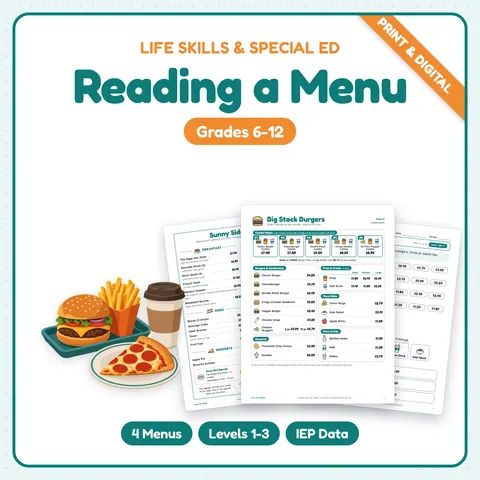
Reading a menu: a good first community skill
Menus combine reading, prices and talking to a stranger. A sequence that works over four or five short sessions:
- Vocabulary first (10 minutes). Entrée, side, combo, to go, subtotal, tax, tip. Show each word with a picture.
- One menu, three levels (20 minutes). Everyone uses the same menu. Some students circle a price, others add two items, others work out tax and stay under a budget.
- "Do I have enough?" (10 minutes). Give each student a set amount, such as $10, and have them plan an order that fits.
- Role-play the order. One student is the cashier, one orders from a short script. Then swap.
If a student freezes during the role-play, hand them a written order card to read word for word the first time. Fade the script later.
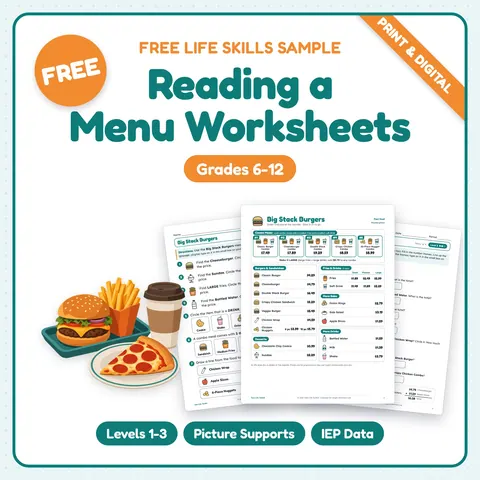
Our free Reading a Menu Life Skills Worksheets sample has one fast-food menu with Level 1, 2 and 3 question pages and an IEP data sheet, so you can try this sequence this week. The full Reading a Menu Life Skills Worksheets adds diner, pizza place and coffee shop menus, ordering scripts, eight role-play order cards and a pre/post skills check.
Grocery shopping and the next-dollar-up strategy
Next dollar up is one of the most useful money strategies students can learn, because it works without making change in your head. Look at the dollars in the price, then hand over one more dollar.
- $3.29: pay $4.
- $7.85: pay $8.
- $12.00 exactly: pay $12. This one catches students out, so include it on purpose.
What usually goes wrong: students read the cents as dollars, or round down. Cover the cents with a sticky note so only the dollars show, say the amount aloud, then add one more.
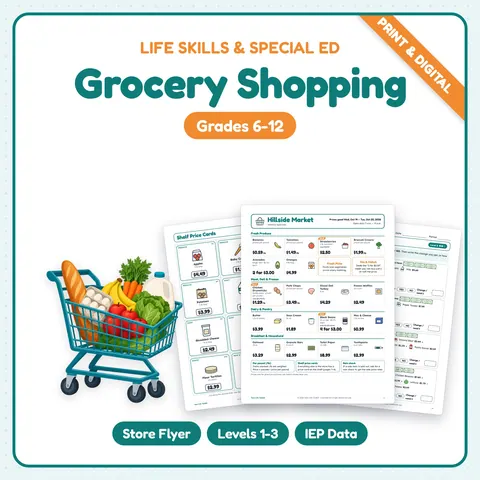
Once next dollar up is steady, build to "Do I have enough money?", shopping within a budget and, for some students, comparing unit prices and checking a receipt for an overcharge. A store flyer and shelf price cards let you run it all as a pretend shop before a community trip.
Grocery Shopping Life Skills includes a weekly store flyer, 24 shelf price cards, leveled pages from finding prices to comparing unit prices, date labels, a receipt check and a shopping trip planner.
Schedules, calendars and getting places on time
Clock worksheets alone rarely carry over to real life, so use real formats:
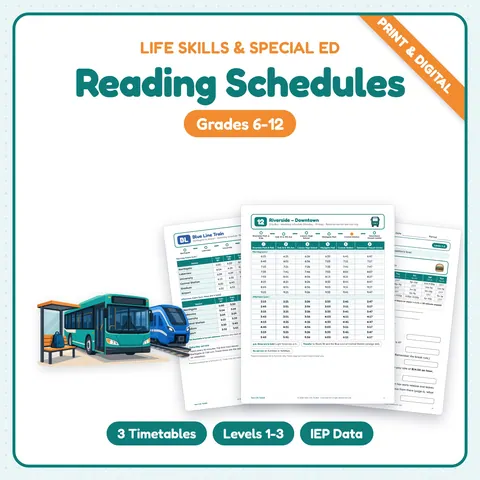
- Bus and train timetables. Teach "read across, read down" with a finger or a ruler. Start with "What time does the bus leave Main Street?", move to "Which bus gets me to work before 9:00?", and finish with a trip that needs a transfer.
- Work shifts. How long is the shift, and is the break paid? Suddenly elapsed time matters.
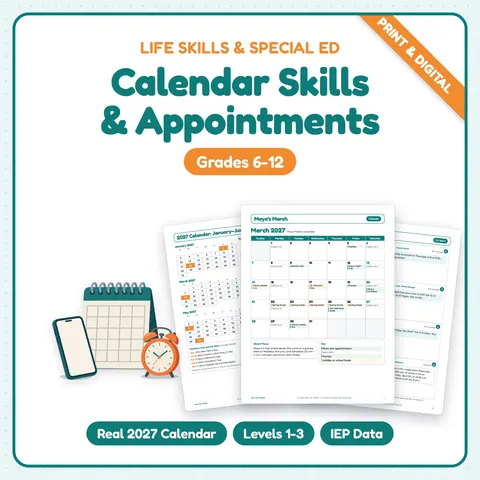
- Calendars. Write dates in words and numbers, count the days until an event, and turn a voicemail into a calendar entry.
A strong end product is a student's own daily schedule, or a practice phone call to book an appointment, rehearsed with a script first. Reading Schedules Life Skills covers bus, train, work shift, movie and bell schedules. Calendar Skills & Making Appointments uses the real 2027 calendar, with voicemail cards and a phone script for booking a doctor or dentist appointment.
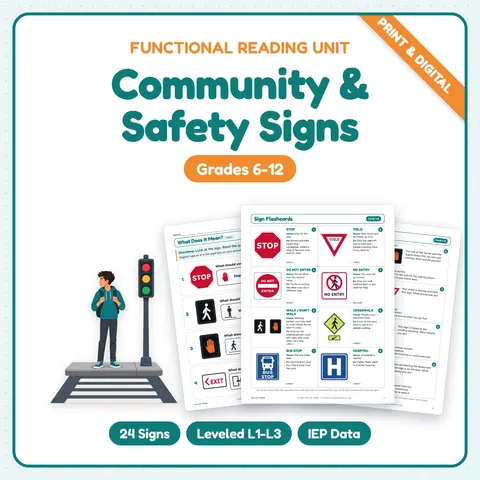
Community and safety signs
Teach about eight signs at a time, and point out that shape and color are clues before a student reads a word: a red octagon means stop.
Then get out of the room. A short walk around school with a checklist ("Find EXIT. Find RESTROOMS. What do you do at this sign?") is real practice and a natural data point. Community & Safety Signs has 24 signs as flashcards, matching and meaning pages at three levels, a cut-and-sort, scenario task cards and a community walk scavenger hunt.
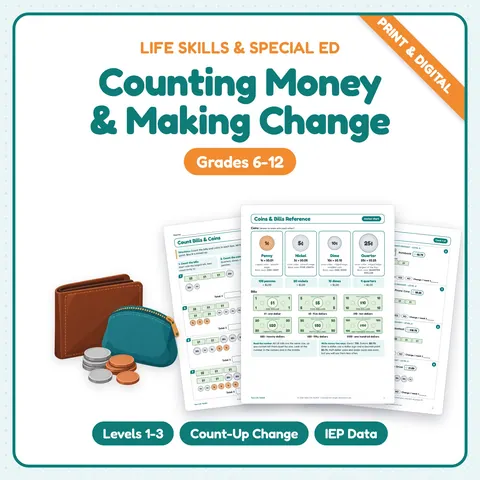
Counting money and making change
Teach counting up from the price, the way a cashier does. If something costs $6.40 and the customer pays with $10, count coins up to $7.00 (60 cents), then bills up to $10.00 ($3). The change is $3.60.
A classroom store or a school store shift is the best practice we know, with students taking turns as cashier and customer. Counting Money & Making Change Worksheets includes printable practice money, a campus store with price tags, "Do I have enough?" purchase cards and a cashier role-play with customer cards.
Personal information and forms
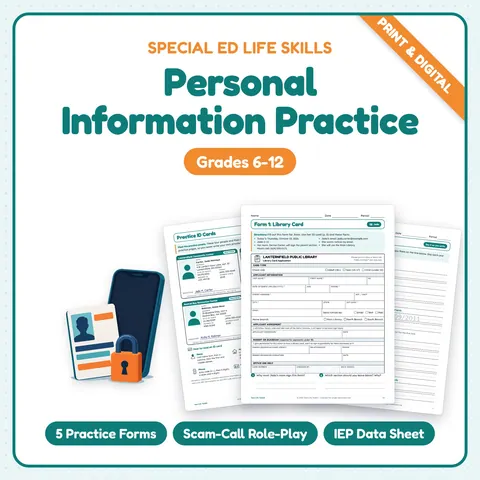
Saying and writing your name, address, phone number and date of birth appears on many transition plans. Practice with fictional people first, then let students fill in their own details with an adult's help, and let families decide what to include. Add a short lesson on what is private and what is OK to share, and role-play hanging up on a scam call.
Personal Information Practice has practice ID cards for fictional people, five realistic forms, a private-or-OK-to-share sort and a scam-call role-play.
Everyday words and real documents
Some students read fluently but miss the detail that matters, like a "closed Mondays" note or a changed pickup time. Two quick ways to practice:
- Functional vocabulary. Teach the words on notices and labels, then have students use them on short missions. Everyday Word Missions for Teens teaches 60 useful words through original notices, matching games and everyday missions.
- Compare two documents. Give pairs two related documents and ask, "What detail changes what we should do?" Functional Reading Detectives is built on 20 of these two-document mysteries.
Vocational tasks and task boxes
Task boxes build independent work habits: get the box, do the task, check it, put it away. Keep each box to one skill, with one correct answer per card, so students can work without help and you can see exactly what they know.
- Print on card stock once and reuse the boxes all year.
- Number every card so mixed-up cards go back to the right box.
For job-style practice, set up one station at a time. Model the first order, have students complete two new ones, check after the attempt, then record what support they needed and reset the materials. Life Skills Task Boxes for Special Education gives you 10 functional sets, including money, time, calendars, signs, menus, sorting, routines and measuring. Vocational Task Boxes adds 12 retail, stockroom and order-filling job stations with 144 graduated work orders.
Collecting IEP data without drowning in paperwork
Keep data simple enough that you, or a para, will actually take it:
- One probe per goal per week. Not every worksheet needs scoring.
- Prompt codes (for example independent, gesture, verbal, model, physical) show how much help a student needed, not just right or wrong.
- The same short check before and after a unit shows growth clearly at an IEP meeting.
- A simple line graph helps families see progress at a glance.
The menu, grocery, schedules, money and calendar resources above each include an 8-question pre/post skills check and an IEP data sheet with a progress graph, so your data comes from work students are already doing.
Leveling one activity for different learners
The easiest way to run one lesson for a mixed group: same document, different questions.
- Level 1: large print, picture supports, circle or match answers. Add errorless options while a student is still learning the routine.
- Level 2: simple calculations with number frames and yes/no decisions like "Do I have enough?"
- Level 3: multi-step problems such as tax, budgets, bus transfers or comparing prices.
Group students by the skill they are working on, not by label, and move them up a level when the data says they're ready. Students who use AAC (augmentative and alternative communication) can answer by pointing to a choice or a symbol.
To get these in one place, the Life Skills Bundle groups the menu, grocery, schedules, signs, money and calendar resources with job skills and personal hygiene. Life Skills Bundle 2 adds the task boxes and personal information practice alongside kitchen, fire safety, nutrition and laundry resources.
FAQ
What are functional life skills for high school students?
Functional life skills are the everyday skills a person needs to live, work and get around as independently as possible: reading signs and schedules, handling money, shopping, cooking and personal care. In high school they are often tied to IEP transition goals. The most useful practice uses real-looking materials and ends with a real task in the community.
What is the next-dollar-up strategy?
It's a way to pay without counting exact change: look at the dollars in the price and hand over one more dollar, so $4.62 becomes $5. The cashier then gives the change. Whole-dollar prices are the exception, since $5.00 needs exactly $5.
How often should I collect data on life skills IEP goals?
A short weekly probe for each goal is a manageable rhythm for most classrooms, as long as it fits your district's progress-reporting schedule. Make the probe match the goal exactly. Recording the prompt level as well as accuracy shows growth even before a student is fully independent.