Executive Functioning Activities and Lessons for Middle School
Executive functioning activities for middle school work best when they are short, explicit and repeated: teach one skill, model it out loud, practice it on a realistic scenario, then have students use it on their own work and reflect. Small daily routines, like a planner check or a weekly locker reset, do more than any one-off lesson. Here is what EF skills are in plain words, how to teach them, and routines and games you can start tomorrow.
What are executive functioning skills? (the plain-English version)
Executive functioning (EF) skills are the brain's management skills: the ones that help us plan, start, keep track of and finish things. When we explain them to students, we use one sentence for each:
- Planning and prioritizing: deciding what to do first and how to get there.
- Organization: keeping your stuff and information where you can find it.
- Time management: knowing how long things take and fitting them into the time you have.
- Task initiation: getting started, even when you don't feel like it.
- Working memory: holding information in your head long enough to use it, like a locker combination or three-step directions.
- Focus and attention: staying with a task and coming back after a distraction.
- Flexible thinking: making a Plan B when something changes.
- Self-monitoring: checking your own work and noticing how you're doing.
Some lists also include emotional control and goal-directed persistence (sticking with a goal over time).
One message matters more than any definition: struggling with these skills is not the same as being lazy. Middle schoolers are still developing them, and plenty of adults lean on alarms, lists and calendars to stay on track. Say this out loud early. Students who have been told they "just need to try harder" often relax when they hear it.
Start with a student self-assessment
Before teaching anything, have students rate themselves. It gives you a picture of the class, and it gives each student a reason to care about the lessons that follow.
Keep it low-stakes: it's a reflection tool, not a test or a diagnosis. Students rate statements about everyday habits from 1 to 4, then pick one strength and one skill to work on.
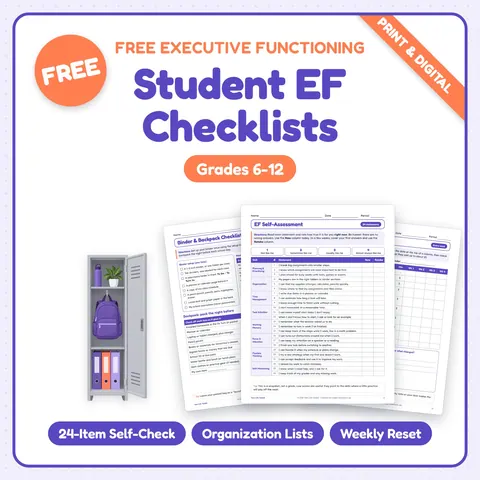
Our free Executive Functioning Self-Assessment & Student Organization Checklist has 24 statements across the eight skills above, a profile graph, a goal builder, a strategy menu, and binder, backpack and locker checklists. There's a retake column, so students can compare their ratings a few weeks later.
How to teach executive functioning skills explicitly
Telling students to "get organized" rarely works on its own. EF skills need to be taught like any other skill. We use the same three steps for each one.
1. Model it out loud
Do a think-aloud with a real task. For planning, put a project due date on the board and plan backward in front of the class: "It's due Friday. I need a draft by Wednesday, so research has to be done Tuesday. On Monday I'll pick my topic." Students hear the thinking, not just the finished plan.
2. Practice with a scenario
Next, students apply the skill to someone else's situation: a fictional student with a messy backpack, three assignments due the same night, or a rerouted bus. A character's problem feels safer than their own. Pairs work well here, for 10 to 15 minutes, then a short share-out.
3. Reflect and choose one strategy
Finish with a two-minute reflection: "Which strategy would you actually try this week?" Students add it to a personal toolkit page and check in on it a week later. That check-in is where most of the learning happens, so protect the time for it.
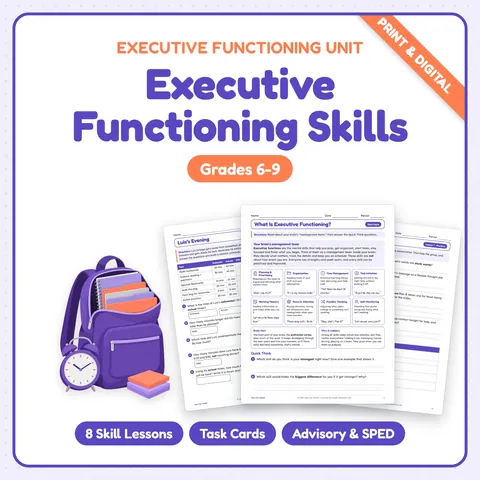
Executive Functioning Activities for Middle School follows this pattern, with eight mini-lessons, a realistic practice page for each skill (like Maya's Busy Week and Backpack Rescue), scenario task cards, a personal strategy toolkit and a weekly reflection log. Each skill takes one 30 to 40 minute session, or you can teach one a week in advisory.
Short daily routines that build EF
Lessons introduce a skill. Routines turn it into a habit. Pick one or two and keep them going all semester.
The two-minute planner check
At the start or end of class, students write down what's due, then circle the one thing they'll do first tonight. Walk the room and initial planners for the first few weeks. Once it's routine, have partners check each other.
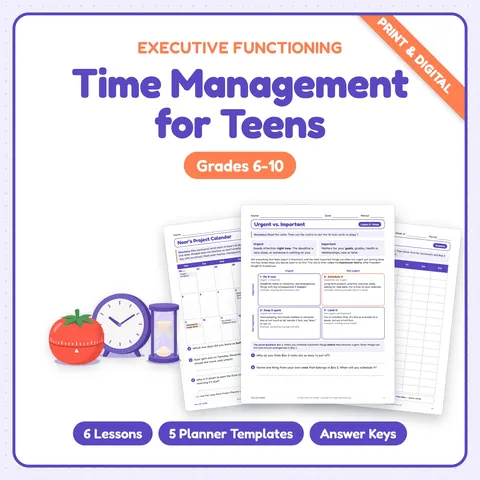
If students resist a paper planner, offer a choice of layouts: a classic weekly page, a time-block version or a simple daily to-do list. Time Management Activities for Teens includes five planner templates plus lessons on urgent vs. important, backward planning, estimated vs. actual time and the Pomodoro technique.
The weekly binder, backpack and locker reset
Once a week, give students 15 minutes to empty backpacks, file loose papers and recycle what they don't need. Put it on the calendar so it actually happens. A checklist turns "clean out your binder" into steps students can follow on their own. The free checklist kit above includes a 15-minute weekly reset routine with a four-week tracker.
Getting started: the first tiny step
For students who sit and stare at a blank page, "just start" isn't a strategy. Teach them to name the first tiny step ("open the document and type the title") and to try a five-minute start: work for five minutes, then decide whether to keep going. Other strategies that help:
- chunking a task into smaller parts
- when-then plans ("When I've eaten a snack, then I'll do math")
- working next to someone else who is also working (body doubling)
- deciding in advance what "done" looks like
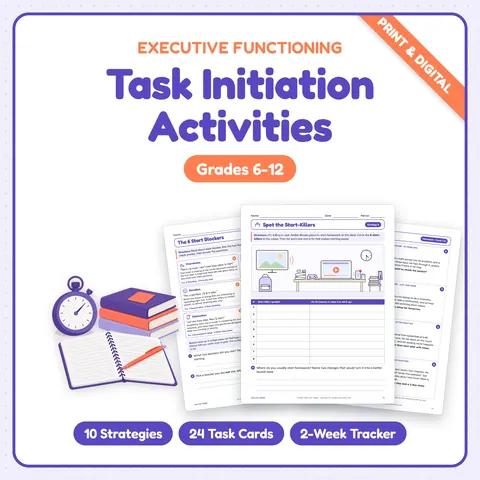
Task Initiation Activities teaches ten start-up strategies like these, with a procrastination self-check, 24 scenario task cards, a start-up routine builder and a two-week tracker.
Digital folders count too
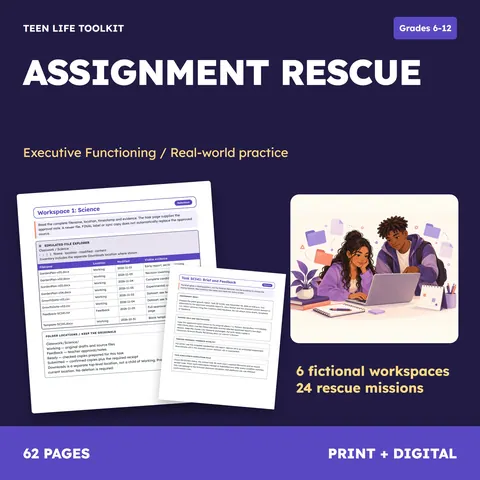
Many "lost" assignments are really lost files: the wrong version, the wrong folder, or work that was never submitted. Spend one lesson on naming files and checking the submission screen. Digital Organization for Students has students rescue six fictional school workspaces through 24 file, folder, version and submission missions, with no real account needed.
Games that build working memory
Working memory games are a fun way in, but we frame them as strategy practice, not brain training. The real goal is for students to find out which supports help them: grouping information, saying it aloud, picturing it or writing it down.
A quick no-prep version:
- Read a list of six items once. Students write down what they remember.
- Teach a strategy, such as grouping the items into two sets of three.
- Read a new list and have students try again using the strategy.
- Compare the two attempts and ask, "Where in real life could you use this?"
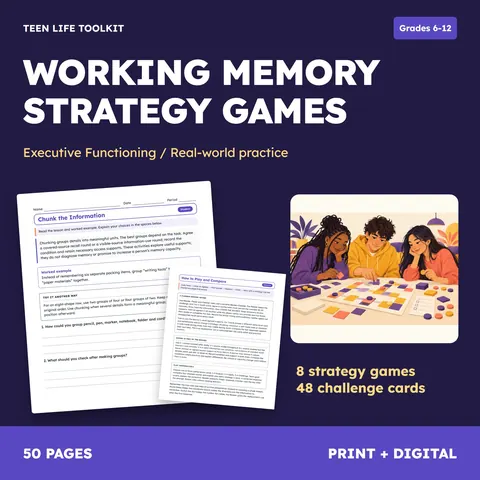
The comparison and the real-life question are what make this EF practice rather than a memory contest. Working Memory Strategy Games builds on this idea with eight cooperative games, 48 challenge cards and a trial log for comparing attempts.
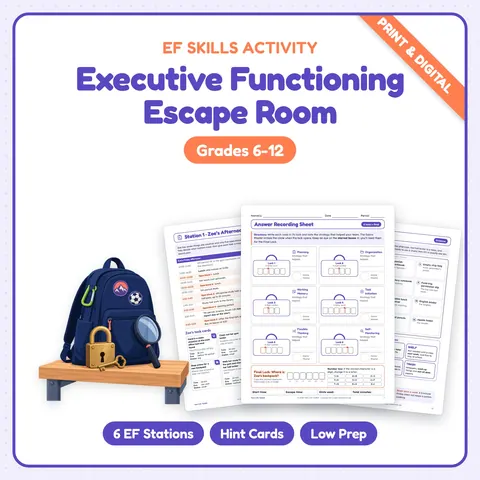
For a full class period, an escape room mixes several skills at once. In the Executive Functioning Escape Room, teams of three or four work through six stations (planning, organization, working memory, task initiation, flexible thinking and self-monitoring) to help a student find her lost backpack, then debrief which skill was hardest for their team.
Planning a semester of EF lessons
If you have a weekly advisory or study skills block, a simple shape works well:
- Week 1: self-assessment and one goal.
- Weeks 2 to 11: one skill per week. Teach a mini-lesson, practice, then use the skill on real assignments.
- Week 12: retake the self-assessment and compare.
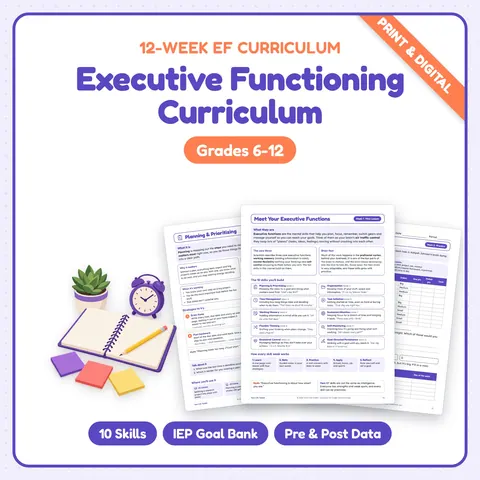
The Executive Functioning Curriculum is built on this 12-week shape. It covers ten skills, with a pre/post self-assessment, weekly goal check-ins, family take-home notes and an IEP goal bank.
The Executive Functioning Activities Bundle pairs the curriculum with Task Initiation Activities, the escape room and Logic Puzzles & Brain Teasers. If you also teach study skills, the Executive Functioning Bundle groups the middle school EF unit and time management lessons with study skills, Cornell notes, goal setting and self-advocacy.
When EF lessons aren't working
- Students fill in planners but never look at them. Shrink the routine. One line ("first thing tonight") beats a full page nobody reads.
- Everyone can name the strategies, but nothing changes. Move practice onto real assignments. A strategy used on tonight's homework counts for more than one used on a worksheet.
- A student rates every skill as a strength. Look at evidence together, like missing or late work. Keep it curious, not punitive.
- You've run out of time. Keep the routine and drop the lesson. Two minutes of planner check every day is worth more than a lesson you never get to.
FAQ
What are the main executive functioning skills?
Lists vary, but a common set for school is planning and prioritizing, organization, time management, task initiation, working memory, focus, flexible thinking and self-monitoring. Some lists add emotional control and goal-directed persistence. For students, the exact list matters less than knowing their own strengths and stretch areas.
How long should an executive functioning lesson be?
A focused lesson of 20 to 40 minutes is plenty: a short model, some scenario practice and a reflection. What makes the skill stick is the follow-up routine, like a daily planner check or a weekly reset, which only takes a few minutes. In a short advisory period, split one lesson across two days.
Can I teach executive functioning in a general education class?
Yes. Planner checks, backward planning for projects, chunked directions and a weekly binder reset help every student, not only those with EF goals on an IEP. Students who need more support can get extra check-ins or small-group practice on top of the whole-class routine.